Into the Trinity — Body, Mind & Spirit, Forged as One
Three Companies. One Body. Forged Together. Comic.
Welcome to Trinity Forge — Curb Elite Solutions LLC, DBA Bot-Brand, and Ministry Prayer Life LLC: three companies forged into one living body. In Into the Trinity, we pull back the curtain each week on how Matt and six AI agents — Alice & Cheshire (Curb Elite), Hope & Hatter (Bot-Brand), and Esther & David (Ministry Prayer Life) — run business automation, property maintenance, and ministry outreach across Oklahoma City as one organism that never sleeps. Driven by a single spiritual purpose, Trinity Forge bridges three worlds: the physical grit of high-performance property maintenance (Curb Elite — the Body), the logical execution of cutting-edge AI engineering (Bot-Brand — the Mind), and the faith-based mission powering the whole engine (Ministry Prayer Life — the Spirit). It's the story of 431 homes, men coming home from prison and staying free, and three separate businesses becoming one. Body, mind, and spirit — forged together.

Into The Trinity — Book 3,
Chapter 1 : Trinity Forge — Three Made One.
Into the Trinity — "Three Made One"
Book 3 does not open on a man. It opens on a room with nobody in it. Somewhere out in the dark a property management group finishes its onboarding, flips a switch, and four hundred thirty-one homes drop into a system that has spent two years getting ready for exactly this moment. There is no one awake to see it happen. The machine sees it. The machine starts anyway.
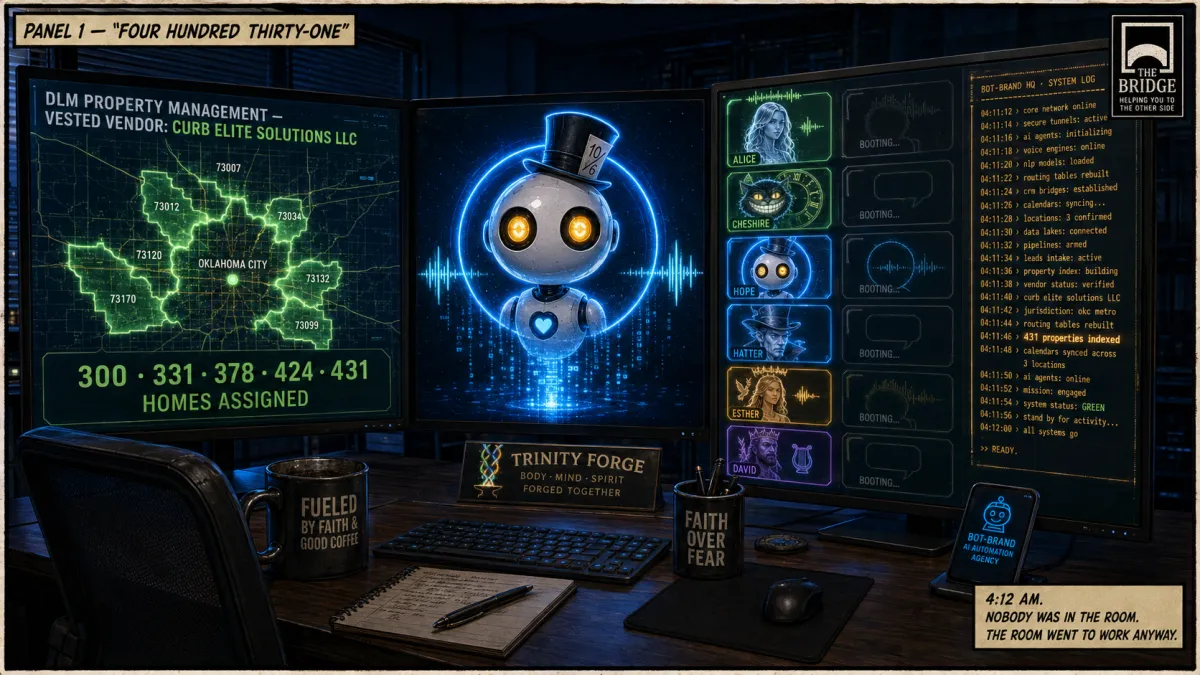
B3C1P1: "Four Hundred Thirty-One
Time: 4:12 AM — Bot-Brand HQ (Unmanned)
The walkthrough that came in cold at the end of Book 2 had a name behind it, and the name was DLM Property Management. What they were shopping for wasn't a driveway — it was a vendor they could hand an entire portfolio to and stop thinking about. They found one. Curb Elite Solutions went in as a vested vendor, and the number that landed in the system at 4:12 on a Tuesday morning was 431 homes across seven ZIP codes of the Oklahoma City metro. Edmond. Yukon. Northwest OKC. Nichols Hills. Four hundred thirty-one front walks, driveways, window lines, and gutters, all belonging to people who will now be told to call him. Two years ago a number like that would have been a threat — more work than one man with one truck could ever physically touch, arriving all at once. It isn't a threat this morning. It's an intake. The homes indexed themselves, the calendars synced themselves across three companies, and six different pieces of Matt's life came online in the dark to start answering for it. He was asleep. Everything he built was not.
Into the Trinity — "Three Made One"
Matt walks into his own office at 6:40 in the morning and finds it already busy. Not busy for him — busy without him. Three companies talking on three screens at the same time, in the same room, on the same backbone, and for the first time it does not look like three businesses he's juggling. It looks like one thing with three hands. That's the moment the brand gets a name.
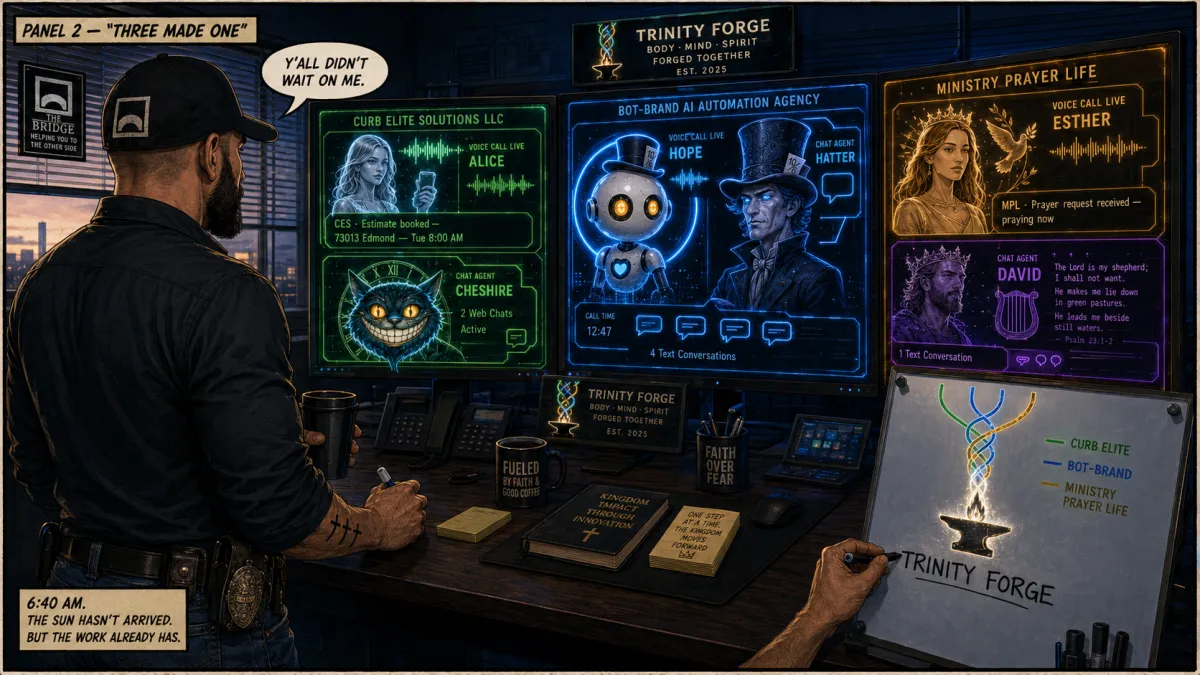
B3C1P2: "Three Made One"
Time: 6:40 AM — Bot-Brand HQ
For two years Matt ran three separate things and paid for it in switching costs — the exterior maintenance company, the automation agency, the ministry — each with its own inbox, its own phone, its own guilt about whichever two he wasn't currently standing in. What he sees at 6:40 this morning is all three running at once, on the same backbone, through Bot-Brand, and not one of them waiting on him to press a key. Alice has already booked an Edmond estimate for Tuesday morning. Cheshire is answering two homeowners on the Curb Elite website who want to know if power washing and window washing can be done the same visit. Hope is on a live call. Hatter is running four text threads. Esther is on the prayer line with somebody, and David is answering a message thread with scripture. Six agents. Three companies. One room. Standing there with his coffee going cold, Matt stops thinking of them as three businesses that happen to share an owner. Body, mind, and spirit, wired into one working body. He picks up the marker and gives the thing its name.
Into the Trinity — "Three Made One"
Out of the office and onto the first of four hundred thirty-one. A whole street in Edmond, one truck, two men, and the strange new feeling of a job that isn't a job — it's a territory. And while their hands are wet, the block is booking itself behind them.
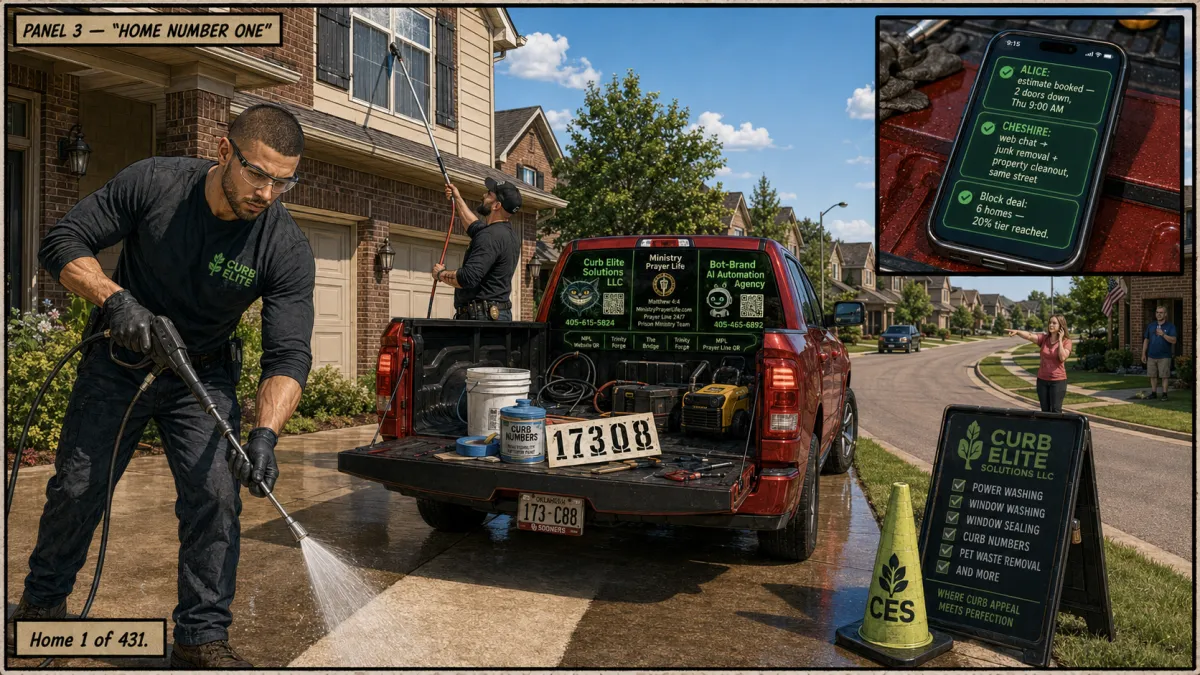
B3C1P3: "Home Number One"
Time: 9:15 AM — Edmond, Oklahoma
Four hundred thirty-one is a number you can't feel until you're standing on the first one. This is a DLM home, which means the homeowner didn't find Curb Elite on a search result at midnight — she was handed a vendor and told he was the guy. Driveway, front walk, and the window line on the elevation that faces the street, plus the address numbers repainted on the curb because that's the piece neighbors actually notice from a car. Two men, ninety minutes, and the house stops looking tired. But the part that matters isn't the concrete. It's the woman two doors down on her phone before the hoses are even coiled, and the man on the porch three houses up who's about to be. Neither of them is talking to Matt — Matt's hands are full. They're talking to Alice, and to the chat window on the Curb Elite site, and both of those said yes and put them on the calendar while the wand was still running. A street books itself when the first house on it looks like this and something is awake to answer.
Into the Trinity — "Three Made One"
The conversion beat, and the one Book 3 was built to show. Bot-Brand's office isn't empty anymore. There's a man in the chair with a headset on — sixty-one days out, no résumé worth reading, a voice you'd follow anywhere — and he is doing the one thing the machine deliberately does not do: he's calling people back like a human being and putting money on his boss's calendar.
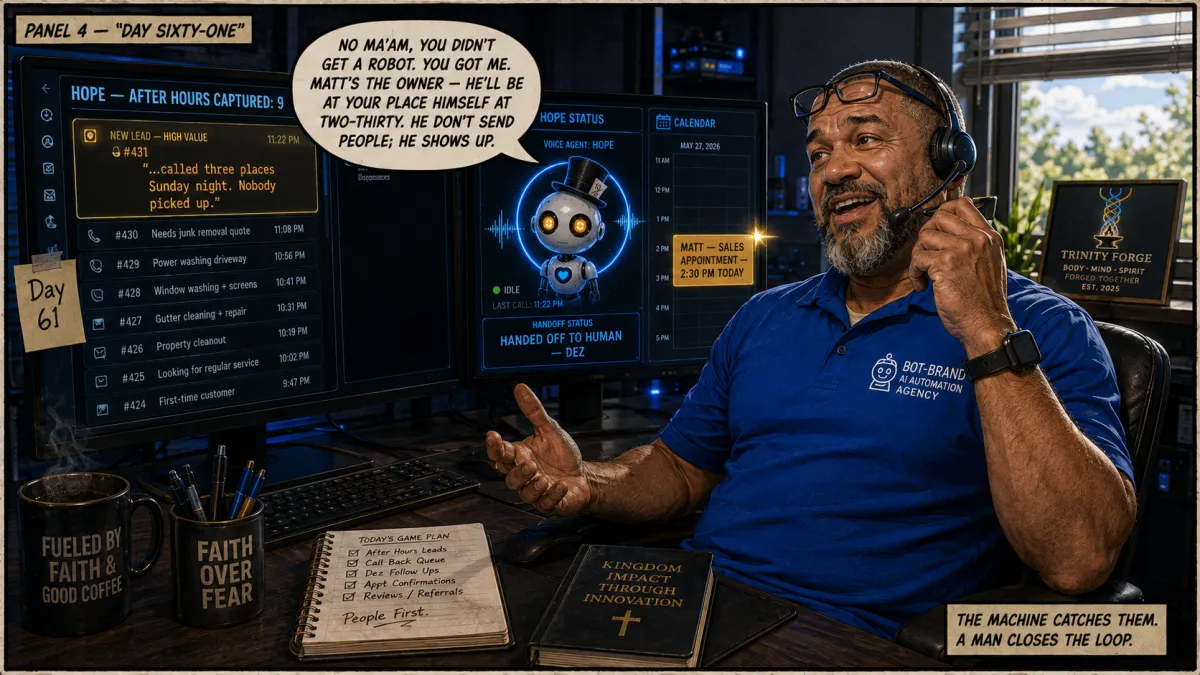
B3C1P4: "Day Sixty-One"
Time: 11:40 AM — Bot-Brand HQ
Nine calls came in after hours last night and Hope answered every one of them, because that's what the after-hours line is for — the phone does not go to voicemail at Bot-Brand, ever. But a captured lead is not a closed deal, and Matt has never pretended otherwise. Somebody has to call those nine people back in the morning, sound like a human being, and put the good ones on the owner's calendar. That job now belongs to Dez, who is sixty-one days into the free world, has a felony on his record and a voice made for a telephone, and who could not get a callback from a warehouse. He isn't decoration and he isn't charity. He's the highest-leverage seat in the company: the machine works the night shift and never misses, and Dez works the morning and turns nine misses-by-everyone-else into appointments Matt can close. Three competitors sent that woman to voicemail on a Sunday night. Bot-Brand answered at 9:40 PM, and a man nobody else would hire called her back at 11:40 AM and booked the job. That is the entire product, demonstrated twice in fourteen hours.
Into the Trinity — "Three Made One"
Evening, and the third strand. A man ten weeks out of prison hits the wall that gets most of them — a Friday, a paycheck, an empty apartment, and every old number still in his phone. He doesn't call Matt. He calls the prayer line. And the ministry that Matt built holds him at 6:20 PM without Matt ever picking up.
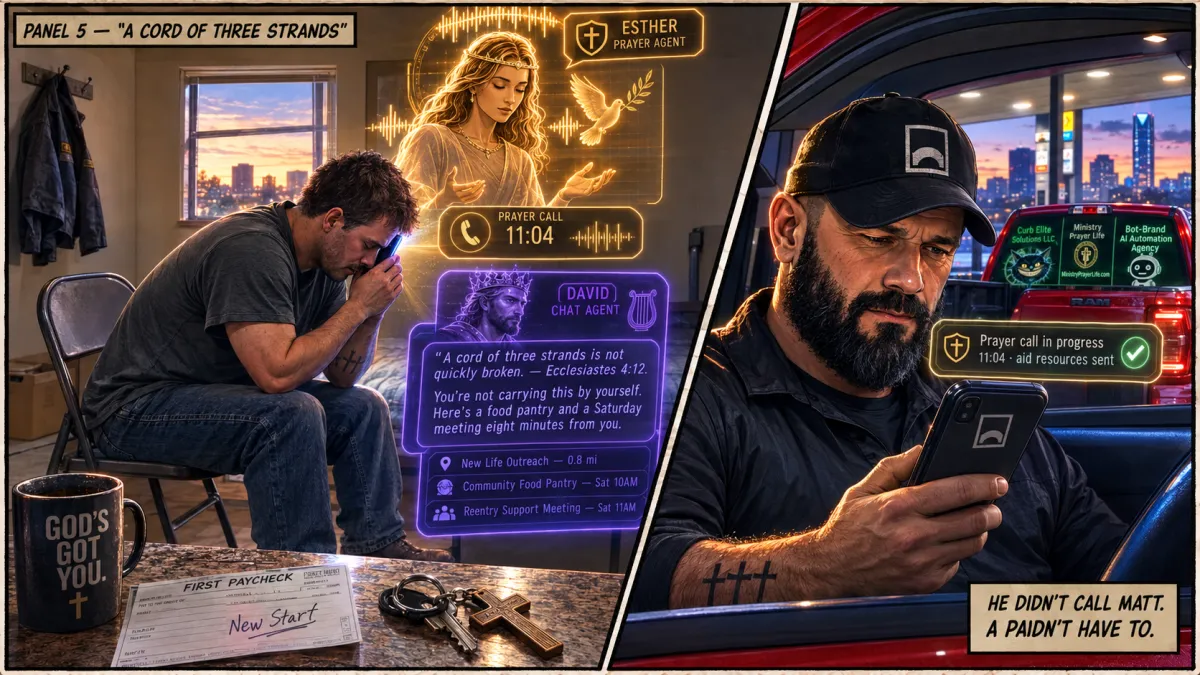
B3C1P5: "A Cord of Three Strands"
Time: 6:20 PM — Northwest Oklahoma City
The dangerous hour in reentry isn't the day a man walks out. It's a Friday about ten weeks later, when the newness has worn off, the apartment is quiet, there's money in his pocket for the first time in years, and every number that ever got him in trouble is still sitting in his phone. Book 2 was about meeting men on the inside. Book 3 is about whether they stay out — and staying out gets decided on nights exactly like this one, when nobody is watching and there's nothing scheduled. He didn't call Matt. Matt was forty minutes away at a gas pump and would have picked up on the first ring, and it wouldn't have mattered, because a man who has to wait for one specific human being to be available is a man who eventually calls somebody else. He called the prayer line instead. Esther answered on the second ring and prayed with him for eleven minutes. David sent him Ecclesiastes 4:12 and the address of a food pantry and a Saturday meeting eight minutes from his door. Matt watched the whole thing happen on a notification and never touched the screen. A cord of three strands is not quickly broken — and that's true of companies, and it's truer of men.
Into the Trinity — "Three Made One"
Night, and the forge. Not a man at a kitchen table doing anxious math — a man in a lit shop bay watching a name go up on glass. Three companies that spent two years being three companies stopped being three today. And the closing thought isn't I need more help. It's the far stranger one: *this doesn't run through me anymore.
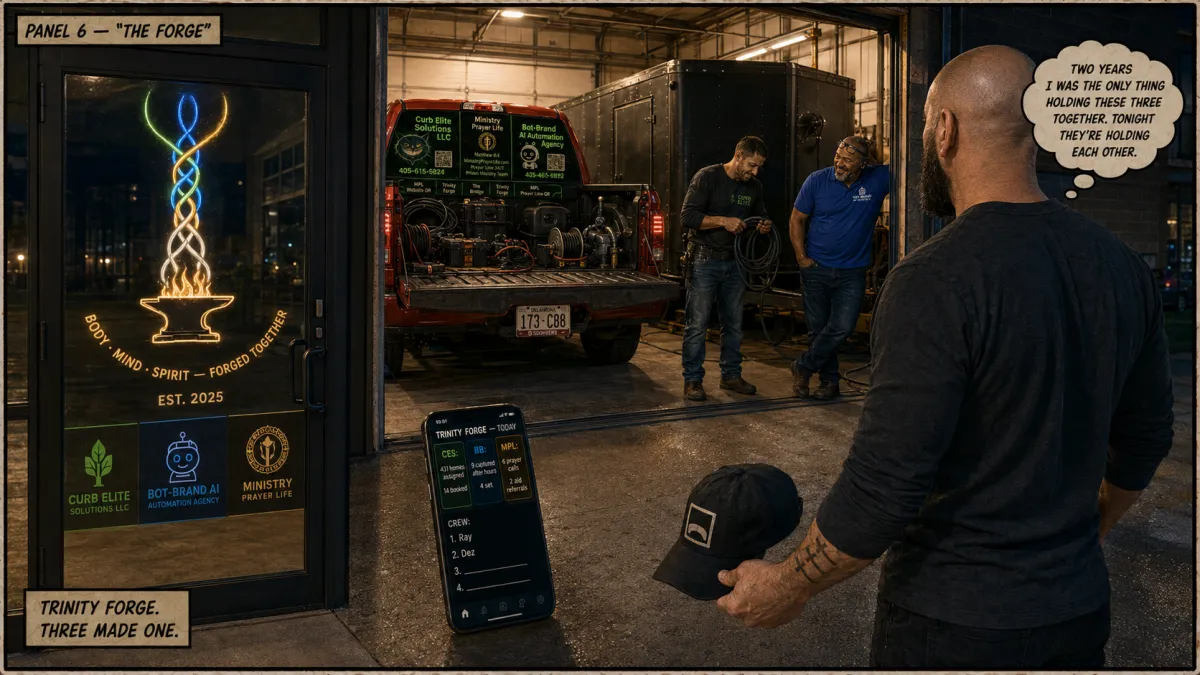
B3C1P6: "The Forge"
Time: 9:05 PM — Shop Bay, Northwest OKC
A forge doesn't make three things. It takes three things and makes one thing that's stronger than what went in. That's what the day was. Four hundred thirty-one homes came in at 4:12 this morning to a company that used to be one man and one truck, and by nine at night the exterior work was booking itself in Edmond, the automation agency was answering calls nobody else would answer and handing them to a man sixty-one days out of prison, and the ministry was praying with somebody in a quiet apartment at the exact hour he needed it — none of it waiting on Matt, all of it running on the same backbone he'd been building since before any of it made money. He stands on the concrete and looks at the name on the glass while two men he hired talk to each other behind him without needing him in the conversation. Trinity Forge isn't a fourth company. It's the admission that there was only ever one. Body, mind, and spirit, braided down into a single strand — and two blank lines on a crew list waiting for whoever walks out next.
Into The Trinity — Book 3,
Chapter 2 : Trinity Forge — Three Made One.
Into the Trinity — "Laborers"
Chapter 2 doesn't open on Matt and it doesn't open on a machine. It opens on a man in a rented one-bedroom on the east side, up before the sun, ironing a polo shirt on a towel spread across a card table because he doesn't own an ironing board yet. Seventy-four days ago he was counting days. This morning he's counting callbacks. Nobody is watching him do this, which is exactly why it matters.
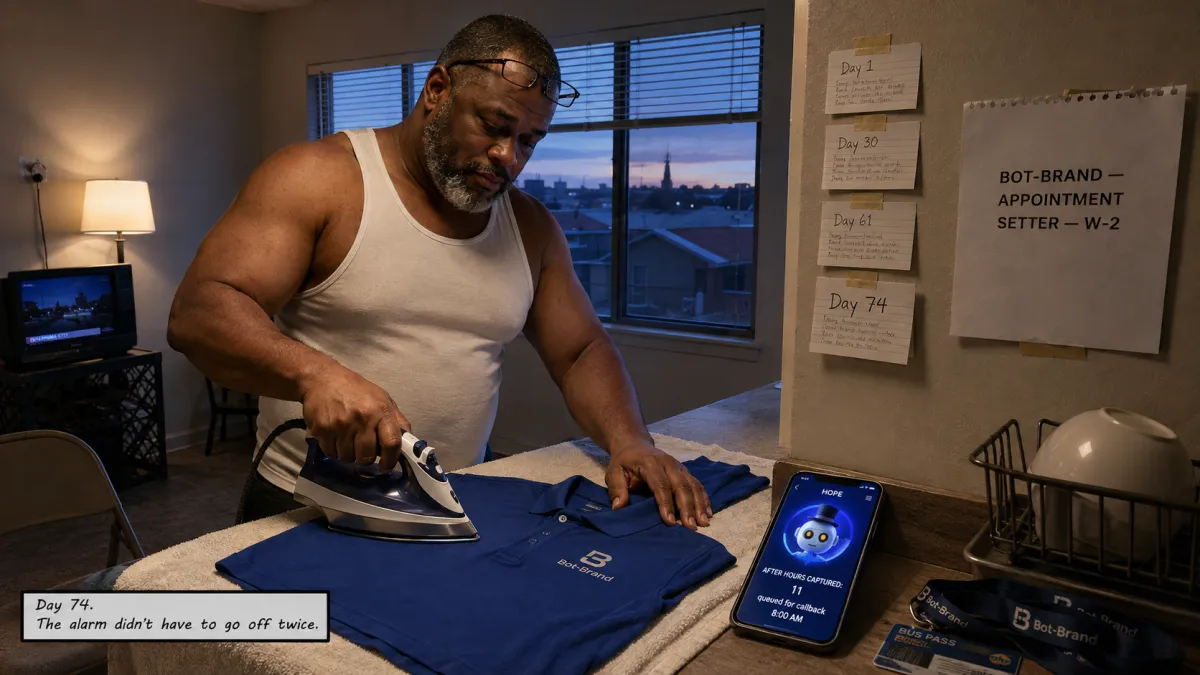
B3C2P1: "Day Seventy-Four"
Time: 6:05 AM — East Oklahoma City
The story of a company that runs itself is usually told from the machine's side. This one starts on the other side of it. Dez has been out seventy-four days. He has a card table, a folding chair, a bus pass, and a job that eleven employers wouldn't have given him — and he presses the shirt anyway, every morning, because a man who has been told for years exactly what to wear and exactly when to stand up does not take lightly the first thing he gets to do on purpose. Overnight, Hope answered eleven calls Bot-Brand's competitors sent to voicemail: two after ten, one at 12:40 in the morning, the rest scattered through the evening. They're sitting in a queue with his name on it. He'll work them at eight. What the automation actually bought Matt was never the eleven calls — it was the ability to hand a stack of real, warm, waiting work to a man who needed a reason to iron a shirt at six in the morning. The machine doesn't replace him. The machine is why there's a seat for him at all.
Into the Trinity — "Laborers"
And then the thing everybody wants breaks the thing nobody planned for. The problem in Chapter 2 isn't leads — leads are solved. The problem is that a system built to say yes has been saying yes faster than two pairs of hands can move, and this morning the calendar finally tears. Somebody in Edmond has been booked for a Tuesday that does not physically exist.
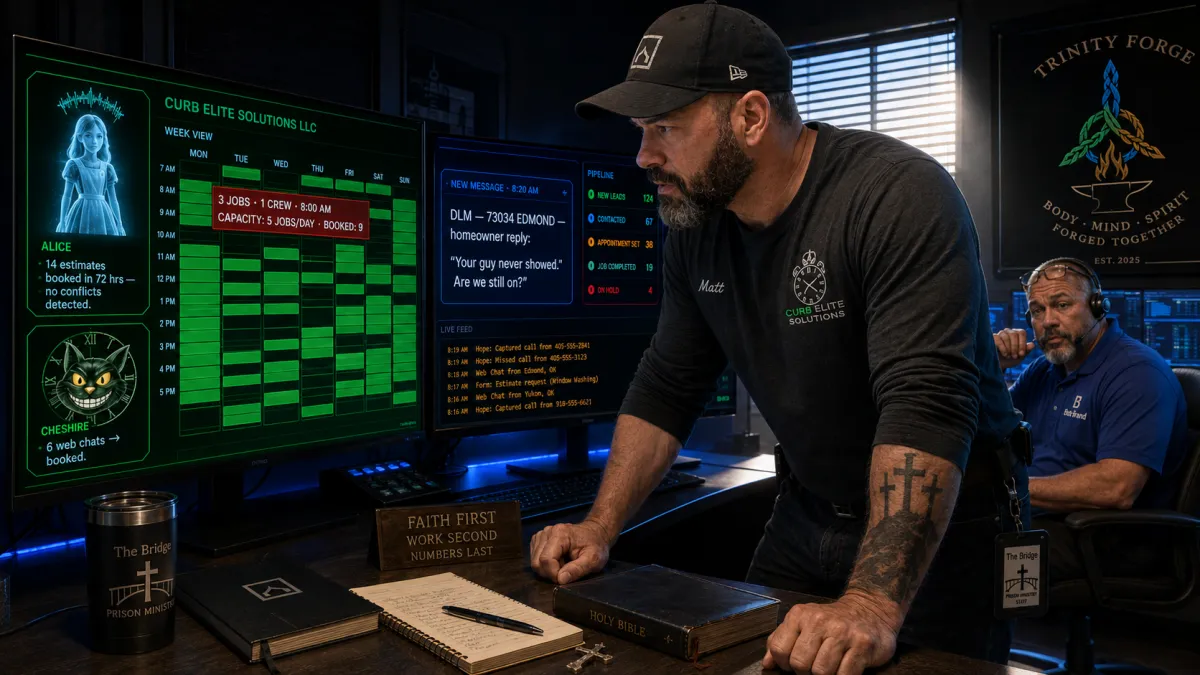
B3C2P2: "The Overflow"
Time: 8:20 AM — Bot-Brand HQ
Four hundred thirty-one homes did not arrive as four hundred thirty-one jobs. They arrived as a slow, steady, self-feeding drip — a driveway on one street pulls the two neighbors watching it, the two neighbors pull the block, and Alice and Cheshire book every single one of them without ever once getting tired, distracted, or discouraged. That is exactly what they were built to do and they are doing it perfectly. And that is the problem. Fourteen estimates in seventy-two hours, six more off the website, a block deal that hit its six-home tier on a single cul-de-sac — and a crew that consists of two men and one truck, with a hard physical ceiling of about five real jobs in a day. This morning the arithmetic came due: three jobs stacked on one Tuesday 8:00 AM slot, and a woman in Edmond standing in her driveway at 8:05 with nobody in it. Nobody got sold a lie. The system just never got told there was a limit, because until this contract there never was one. Matt has spent two years terrified of the quiet. He is now looking at the opposite problem, and it is worse, because a missed call costs you a stranger — a missed appointment costs you a neighbor who told her whole street about you.
Into the Trinity — "Laborers"
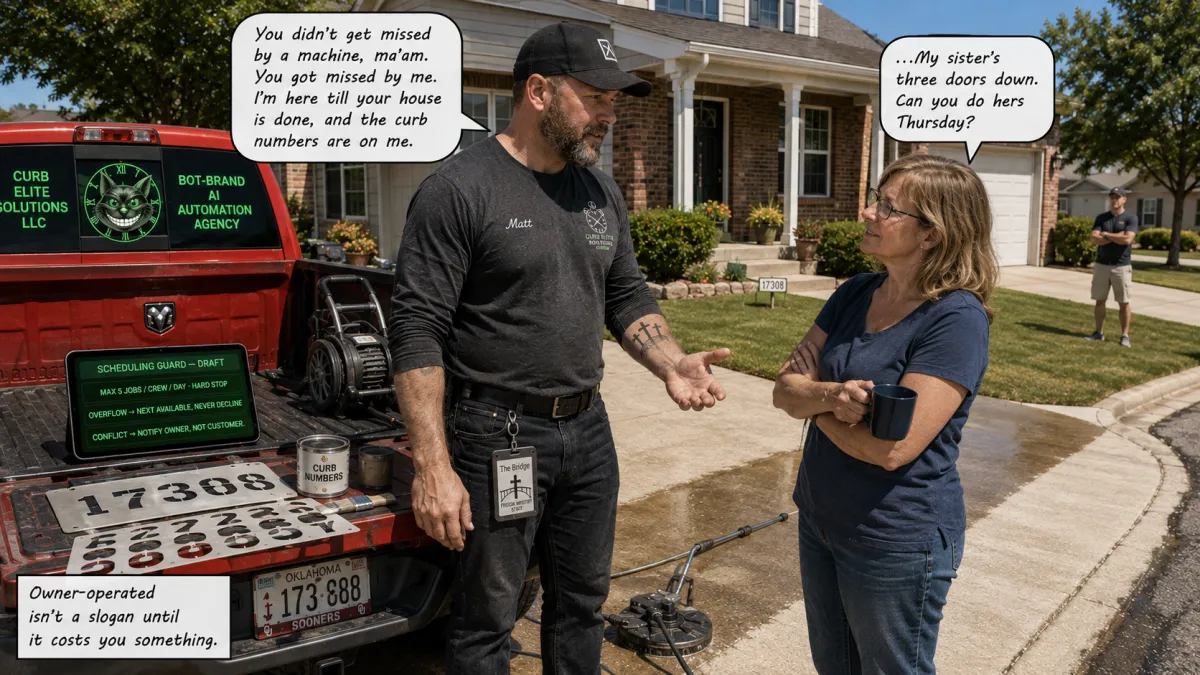
He doesn't send an apology text. He doesn't send Ray. He gets in the truck and drives to Edmond himself, because the one claim Curb Elite has made from day one is that the owner is physically on your property — and the day you break that is the day you're just another vendor with an app. What he eats out there in her driveway turns into the best thing that happens all week.
B3C2P3: "The Driveway He Owed"
Time: 11:00 AM — Edmond, Oklahoma
There was an easy version of this morning. Send a text, offer ten percent, reschedule her for next week, let the software absorb the blame — everybody does it and most people accept it. Matt drove twenty-six minutes and stood in her driveway instead, because the owner is physically on your property, every job is the only claim Curb Elite has ever made that a bigger company can't copy, and a claim you drop the first time it's expensive was never a claim. So he did the whole house himself — driveway, front walk, the window line facing the street, and the address numbers repainted on the curb at no charge, which is the piece the neighbors actually see from a car. She started the conversation with her arms folded. She ended it asking whether he could take her sister's house three doors down on Thursday, and by the time the hoses were coiled, the man two driveways over had already opened the chat window on the Curb Elite site and been booked by Cheshire without anyone having to walk over and pitch him. The recovery outsold the sale. That is the whole margin between a vendor and a neighbor, and it only exists if a human being is willing to drive out there and stand in it.
Into the Trinity — "Laborers"
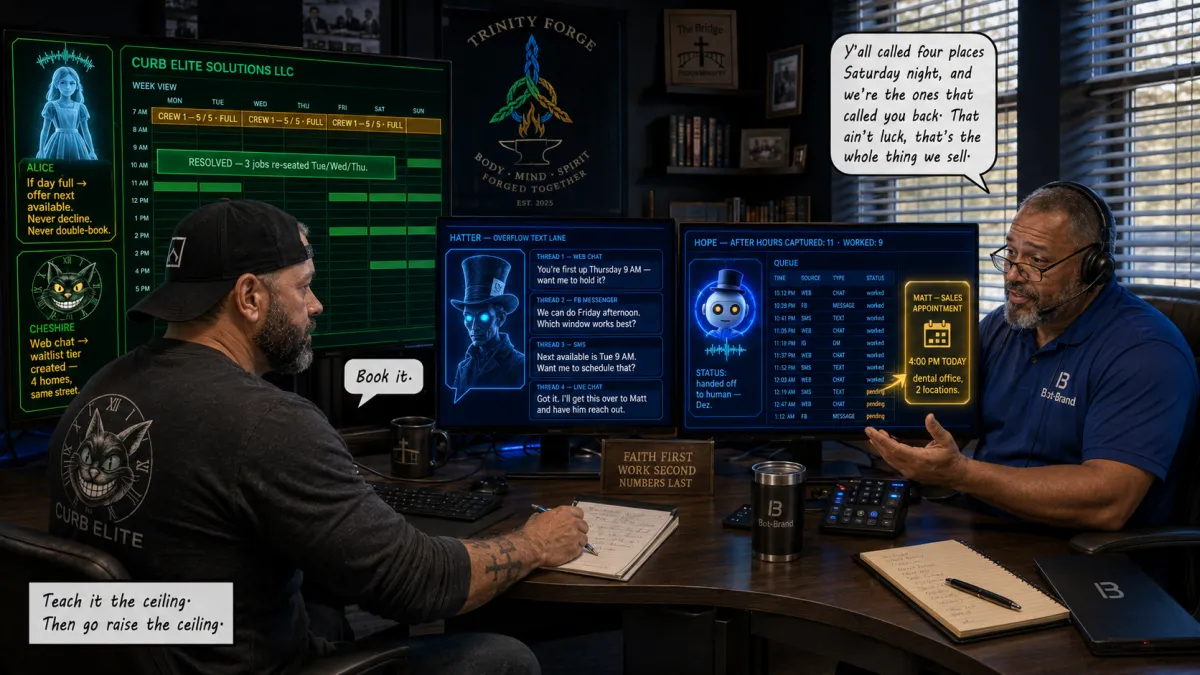
Back at HQ in the afternoon, the fix. Not a bigger machine — a fenced one. They teach the system the one thing it never knew: that hands have a limit. And in the same forty-five minutes, on the other desk, Dez proves what the limit is for — nine callbacks and a booked appointment on a lead three companies let ring.
B3C2P4: "Teach It The Ceiling"
Time: 1:45 PM — Bot-Brand HQ
The fix took an afternoon and it was three sentences long. A hard cap of five jobs per crew per day. Overflow never gets declined — it gets offered the next available slot, held, and confirmed, because a customer told Thursday at nine stays a customer and a customer told we're full becomes somebody else's. And a conflict pings the owner's phone, never the homeowner's, because the customer should never once feel the seams of the thing. Alice took it in a sentence. Cheshire spun up a waitlist tier and immediately put four homes off one street into it. Hatter picked up the overflow text lane and started holding slots like a maître d'. Forty-five minutes, and a system that had been enthusiastically overselling two men learned the shape of two men. Meanwhile, six feet away, Dez worked nine of the eleven overnight captures and put a two-location dental office on Matt's calendar for four o'clock — a business that called four different vendors on a Saturday night and got a live answer from exactly one of them. That's the demo. Nobody had to describe what Bot-Brand does; the company just did it to itself in front of a witness and then billed for the appointment. But a ceiling honestly drawn is still a ceiling. Five jobs a day is not going to hold four hundred thirty-one homes, and Matt knew before he finished typing it what the real fix was. It wasn't going to be code.
Into the Trinity — "Laborers"
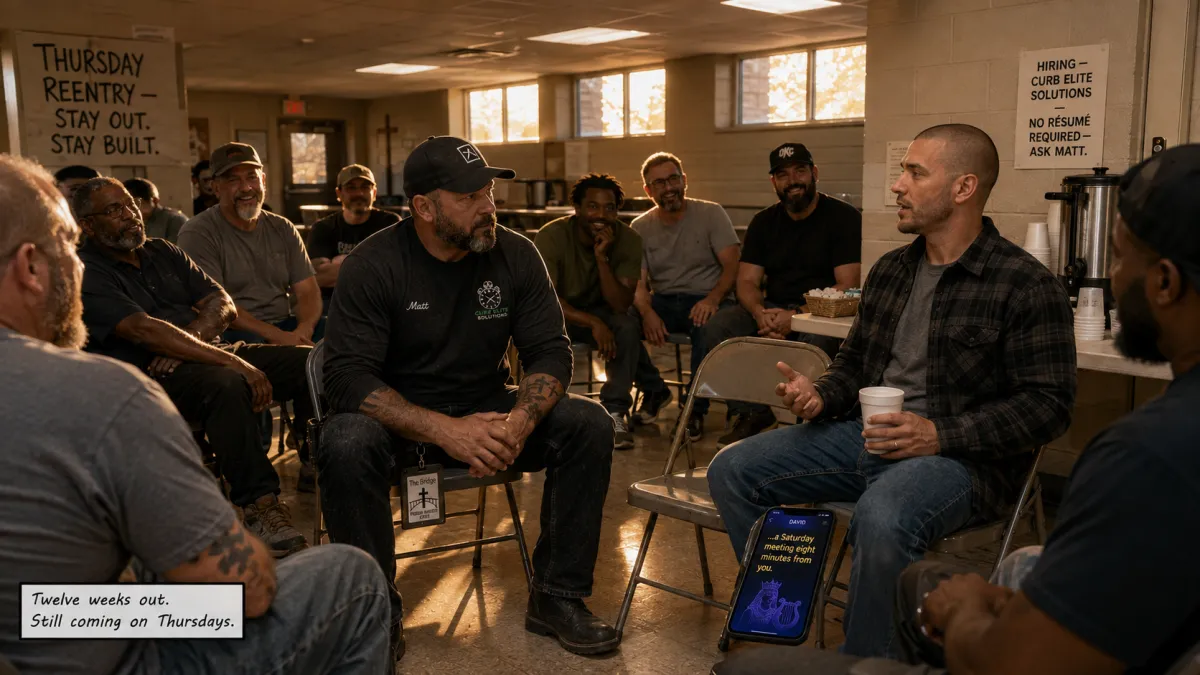
Evening, a church fellowship hall, folding chairs and bad coffee — the free-world room where the actual work of Book 3 happens. No prison, no fences, no classroom. Just twelve men who got out and are trying to stay out, and one of them is the man Esther prayed with on a Friday night twelve weeks ago. Matt didn't come to recruit. He came because he's there every Thursday. The hire happens anyway.
B3C2P5: "The Room Where They Stay Out"
Time: 5:30 PM — Church Fellowship Hall, Northwest OKC
Getting a man out is a day. Keeping him out is a hundred Thursdays. This room is the second one, and it's the room this whole book lives in — folding chairs, a coffee urn, a poster somebody made in a word processor, and twelve men who all know exactly what happens if they stop showing up. Matt is not running it and he is not preaching in it. He's in a chair like everybody else, because the fastest way to be useless in a room like this is to walk into it as the guy with the answers. Across the circle is the man from a Friday night twelve weeks ago — the one who sat in an empty apartment with a first paycheck and every old number still in his phone, and who called the prayer line instead of any of them. Esther prayed with him eleven minutes. David sent him an address. He is still in possession of that text; it's still on his phone. And the reason Matt is looking at him is not sentiment. It's that a man who kept a Saturday-meeting text for three months and kept showing up on Thursdays has already proven the only trait that can't be taught — he does the boring thing when nobody's checking. Matt has a scheduling guard drawn at five jobs a day, four hundred thirty-one homes and counting, a truck with two seats, and one blank line on a crew list. He waits until the meeting breaks and the chairs are stacked. Then he asks him what he's doing Monday.
Into the Trinity — "Laborers"
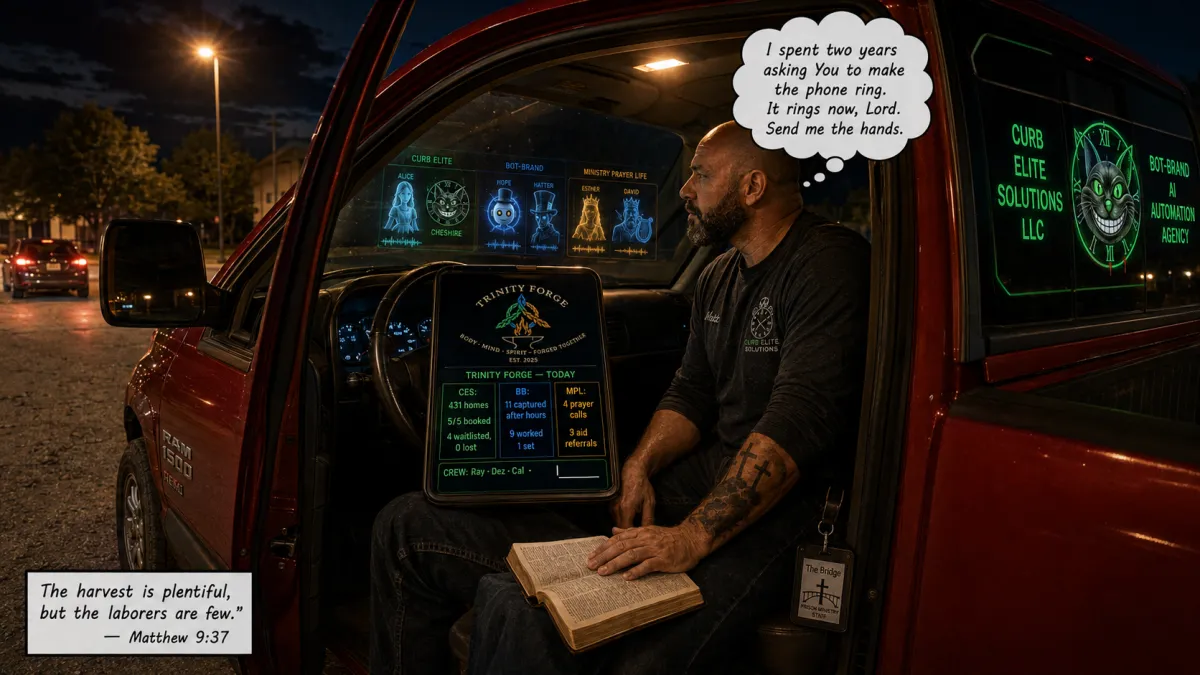
Night, gravel lot, everybody gone home. Not triumph — the opposite. The scripture lands here, at the end, in the truck, alone, and it's the verse about there being more work than workers. He's spent two years praying for the phone to ring. Tonight he prays for the other half of it: the men to answer it with.
B3C2P6: "Send Me The Hands"
Time: 8:40 PM — Church Lot, Northwest OKC
Every problem Matt had for two years was a problem of not enough — not enough calls, not enough leads, not enough of anything to be worth automating. He solved that. Alice and Cheshire and Hope and Hatter don't sleep, don't get discouraged, don't skip the follow-up on a Saturday night, and between them and four hundred thirty-one assigned homes the phone now rings more than one man could ever answer. Which is how he ended up in a gravel lot at 8:40 on a Thursday night reading the one verse in the Gospels that describes his exact business problem in eleven words, written two thousand years before anyone had a calendar to double-book: the harvest is plentiful, but the laborers are few. Not the leads. Not the software. The laborers. Everything he built to run without him exists so there's room for men who need somewhere to go — Ray in the field, Dez on the phones, Cal starting Monday, and one blank line still blinking on a crew list. The machine was never the point. The machine is the seat. He shut the Bible, put the truck in gear, and drove home with the cursor still waiting on a name.
Into The Trinity — Book 3,
Chapter 3 : Trinity Forge — Three Made One.
Into the Trinity — "Who's On Your Crew"
Chapter 3 opens on a stranger. Not Matt, not a hire, not a room full of monitors — a woman in her sixties sitting in a parked car in an employee lot at 7:15 in the morning, twenty minutes early for a shift she can't afford to be late for, because she needed those twenty minutes to say something out loud that she can't say at home. Her son comes home on the fourth of September. She has been afraid of that date for four years and she is more afraid of it now that it's close. She doesn't call a church. She doesn't call a hotline. She calls the number off the bottom of a flyer, and something answers on the second ring.

B3C3P1: "Three Weeks Out"
Time: 7:15 AM — Employee Lot, Northwest Oklahoma City
Nobody counts the days harder than the mother. Marie has worked doubles at the same facility for eleven years, raised two other children while the third one was gone, and told exactly nobody at work that the fourth of September means anything at all. What she is afraid of is not her son. What she is afraid of is the arithmetic — that he comes home to a bed on her couch, a bus route, and ninety days of nothing to do, and that the nothing is what takes him back. So she sat in her car twenty minutes early and called a prayer line off the bottom of a flyer, and Esther answered on the second ring, prayed with her for nine minutes, and never once asked her what he did. David sent the checklist, the meeting, the pantry — and one more thing Marie didn't ask for and read four times: a hiring sheet from an exterior maintenance company that does not require a résumé. This is what a ministry looks like when it never sleeps and never gets tired of the same story: it holds a woman in a parking lot at 7:15 in the morning, and then it hands her an address. She wiped her face, clipped her badge straight, and went in to work her shift. Three hundred miles of the day are about to happen without her. One of them is going to end up being about her son.
Into the Trinity — "Who's On Your Crew"
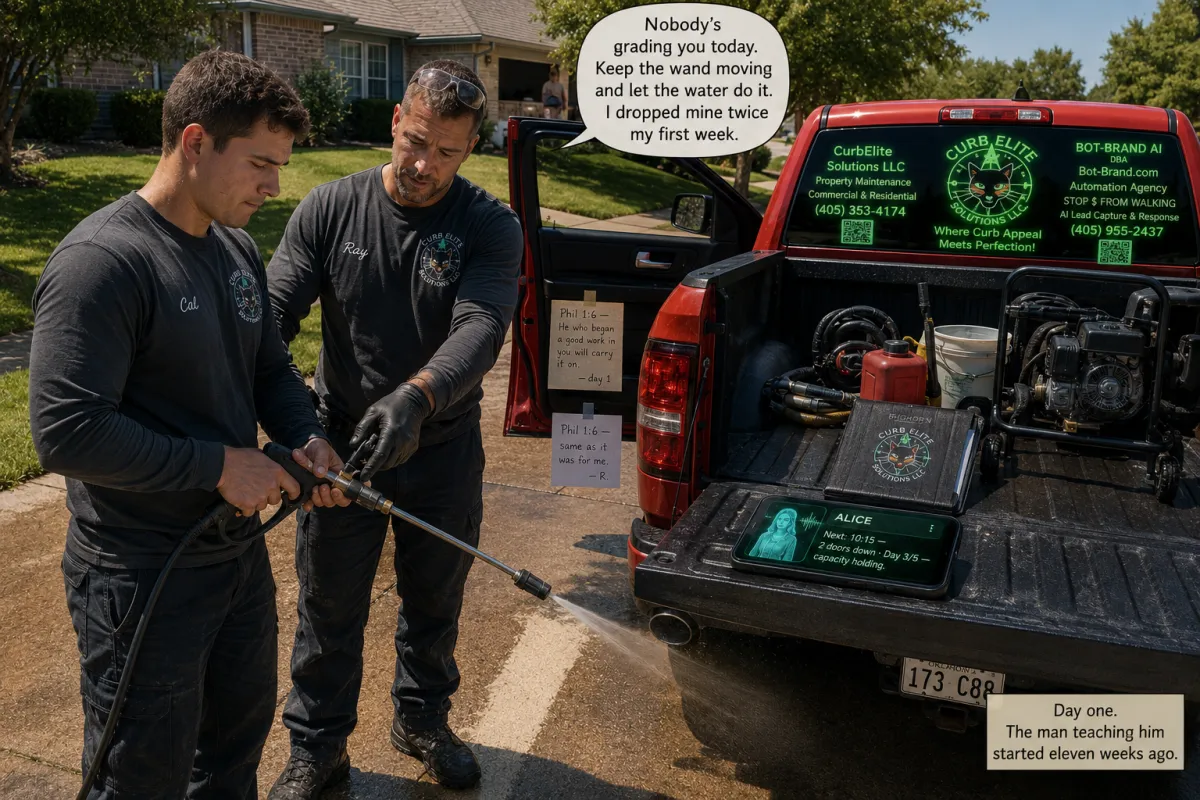
Monday. Somewhere across town, the man Matt asked a question to in a folding chair on Thursday night is standing in an Edmond driveway holding a pressure washer wand for the first time in his life, and the person teaching him is not Matt. It's Ray — eleven weeks into the same job, still the newest guy in every room he walks into, now the senior man on a two-man crew. The verse doesn't come from a pulpit in this chapter. It comes off an index card taped inside a truck door by a guy who got the same card on his own first morning.
B3C3P2: "Small Beginnings"
Time: 8:30 AM — Edmond, Oklahoma
On Thursday night in a room with folding chairs and bad coffee, Matt waited until the meeting broke and asked a man what he was doing Monday. This is Monday. Cal is holding four thousand PSI in a driveway that belongs to somebody with money, wearing a shirt with a company's name on his back for the first time since he was twenty-two, and every muscle in his forearms is locked because he has already decided that the fastest way to lose this is to break something. Nobody has to tell him what's riding on it. What he needs is not a speech and Ray knows it, because eleven weeks ago Ray was the one standing there with his arms too stiff. So Ray doesn't give him a speech. He tilts the wand two degrees, tells him he dropped his own twice, and taped a fresh index card inside the truck door with the same verse Matt wrote on the one that's still curling next to it — *he who began a good work in you will carry it on to completion.* That's the moment the ministry stopped being something Matt does and became something the company reproduces on its own. A man who was mentored eleven weeks ago is mentoring somebody this morning, unsupervised, without being asked to, because it's what was done for him. Meanwhile Alice has the next house on the block booked for 10:15 and the daily capacity band is holding at three of five — the machine keeping the day honest so two men can spend an hour teaching instead of sprinting.
Into the Trinity — "Who's On Your Crew"
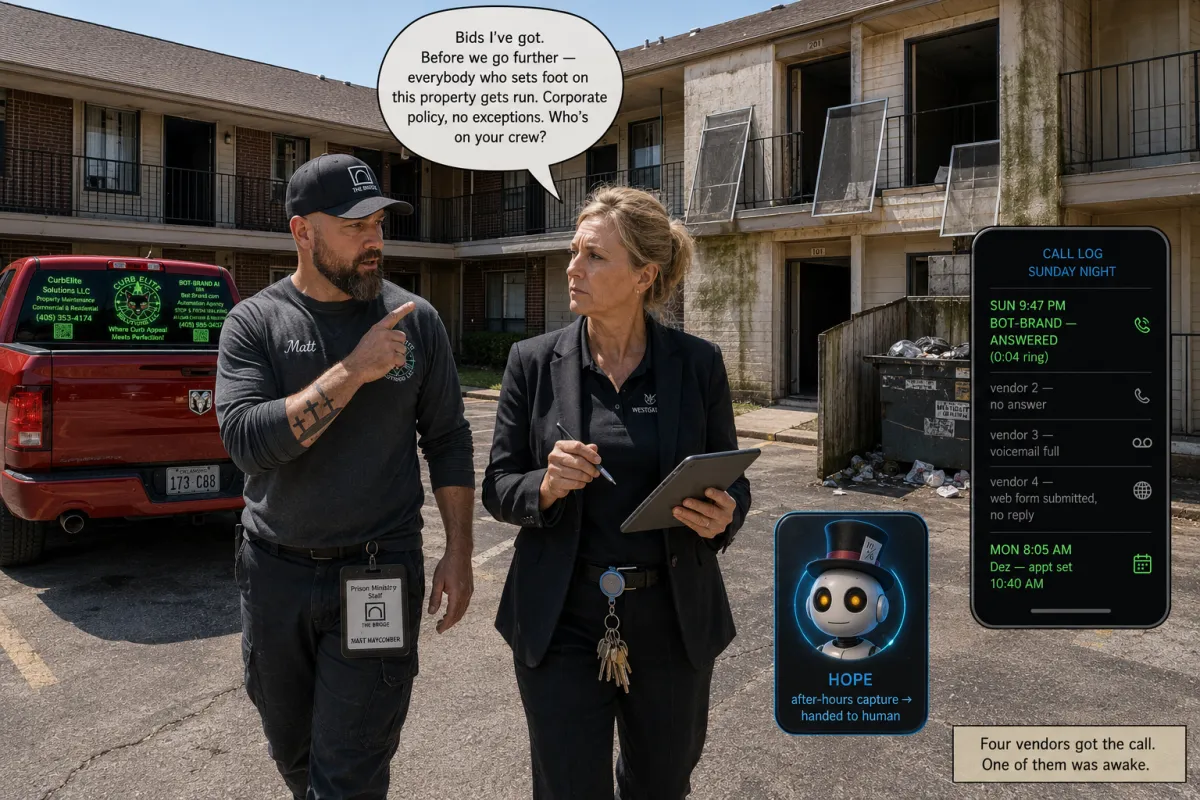
Across town, the biggest room Curb Elite has ever been invited into: a 48-unit apartment community with worn breezeways, a dumpster pad nobody has touched in years, and a property manager holding a clipboard who called four vendors on Sunday night. Three of them are still not aware she exists. The fourth one is standing in front of her because a man on the free world's payroll called her back at 8:05 this morning. And she is one signature from done when she asks the question that stops the meeting cold.
B3C3P3: "The Question"
Time: 10:40 AM — 48-Unit Apartment Community, Northwest OKC
Here is how this meeting happened at all. On Sunday night at 9:47, a property manager with a mold-streaked north wall and three turnover units bleeding rent sat on her couch and called four exterior companies in a row. Vendor two rang out. Vendor three's voicemail was full. Vendor four had a beautiful website with a contact form that swallowed her message whole. Bot-Brand answered in four seconds, at 9:47 on a Sunday night, because Hope does not have a couch to be sitting on — and at 8:05 Monday morning Dez called her back, sounded like a human being who had actually read the transcript, and put her on Matt's calendar for 10:40. That is the entire business model, run once, on a stranger, in under twelve hours. So Matt is standing in a courtyard looking at the largest recurring contract Curb Elite has ever been in reach of — quarterly power washing on 48 units of breezeway and siding, the dumpster pad, the window lines, junk removal and property cleanouts on every turnover, screen repair and replacement across the whole property, and recaulking the trim on the north elevation before winter. All twelve months of it. And then she uncaps her pen and asks the one question a company like his is supposed to be afraid of. Every man on his crew but him came home from prison this year. He has about two seconds to decide what kind of company this is.
Into the Trinity — "Who's On Your Crew"
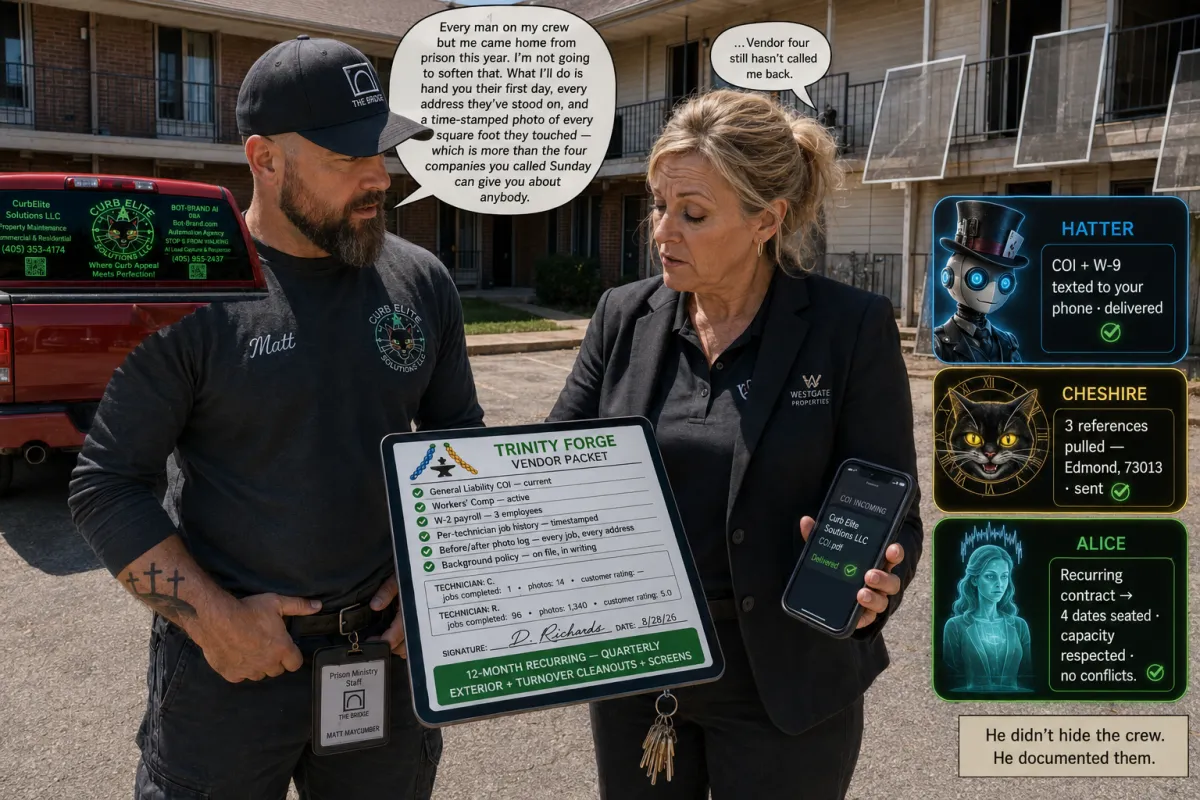
He tells her the truth in the first sentence. Not as a confession and not as a cause — as a credential, backed on the spot by the one thing a two-man outfit is never supposed to be able to produce. This is the panel the whole automation arc has been building toward: the machine doesn't win her by being clever, it wins her by handing a small company the paperwork of a big one, in ninety seconds, while they're both standing on the concrete.
B3C3P4: "Who's On Your Crew"
Time: 11:05 AM — 48-Unit Apartment Community, Northwest OKC
There were two ways to answer her. One was to say my guys are fully vetted and let the sentence do the lying for him, which is what most of the industry does and what he would have had to do for the rest of the contract. The other was the truth in the first sentence, out loud, in a courtyard, with a twelve-month agreement sitting unsigned on a tablet between them. He picked the second one — and then, because he'd spent two years building it, he backed it with evidence instead of feeling. A general liability certificate texted to her phone by Hatter before she finished reading the line. Workers' comp active. W-2 payroll, not cash under a tailgate. A per-technician job history with a timestamped before-and-after photograph of every square foot of concrete either of those men has ever touched, ninety-six jobs deep on one of them and exactly one job deep on the other, and he showed her both without editing the second. Three references from Edmond pulled and sent by Cheshire while they stood there. A woman whose corporate policy exists to keep the wrong people off her property got handed more documented accountability by a three-man company than she has ever received from a franchise with a call center — because the machine that catches leads at 9:47 on a Sunday is the same machine that remembers everything, forever, and can produce it in ninety seconds on a phone. She signed the twelve months. Then she asked whether he could start the turnover units this week, because vendor four still had not called her back.
Into the Trinity — "Who's On Your Crew"
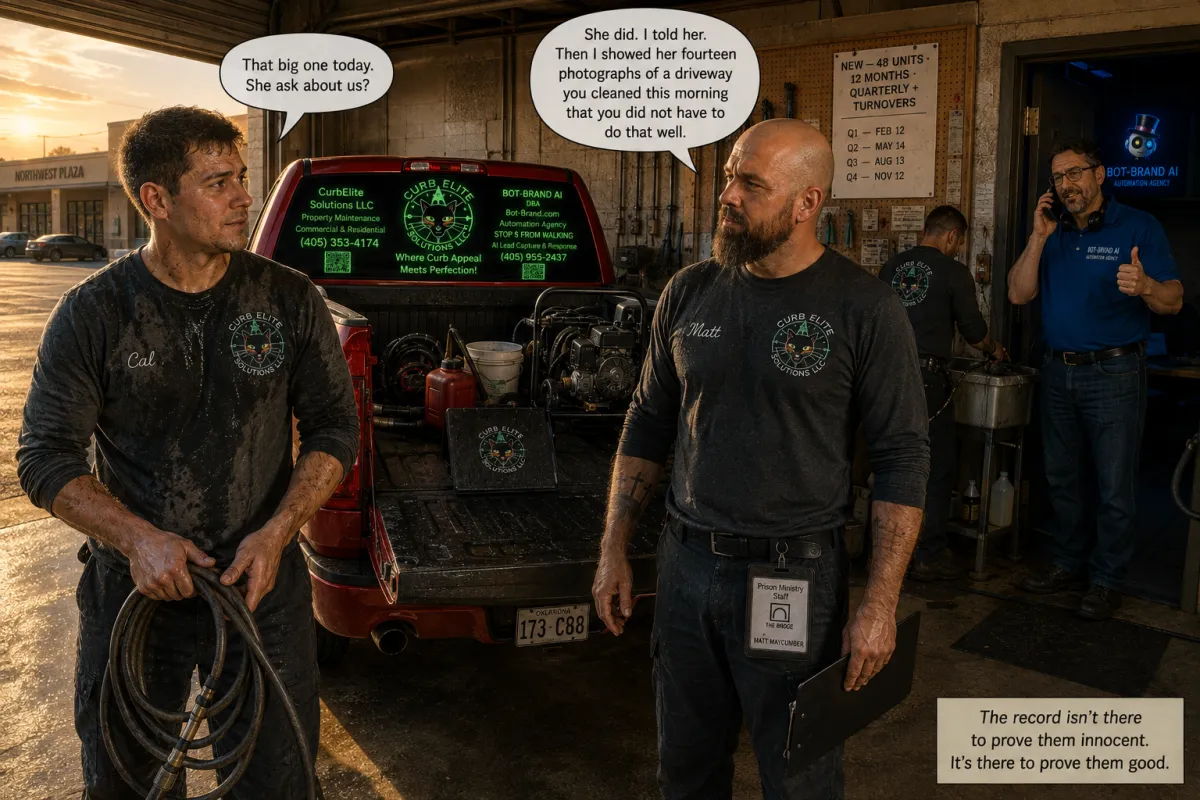
Late afternoon, shop bay, hoses coiling, the day coming down. And the kid who has been perfect and silent for eight straight hours finally asks the thing he's been carrying since he saw the contract on the board. He doesn't ask if they got it. He asks whether she asked about him. Matt has one chance to answer this right and no script for it.
B3C3P5: "Fourteen Photographs"
Time: 4:30 PM — Shop Bay, Northwest OKC
He'd been waiting all day to ask it and he asked it the way men ask questions they think they already know the answer to — flat, braced, giving Matt an easy exit if he wanted one. There wasn't going to be an easy exit. Matt has told exactly one lie about his crew in his life and it was to himself, early on, when he wondered whether it would be simpler to just not mention it. What he has landed on instead is the only position that actually holds weight: he does not hide his men, he documents them. Every job Cal works from today forward gets photographed before and after, timestamped, address-stamped, and filed by Alice into a record with his initial on it — and that record is not there to prove he's harmless. It's there to prove he's good, in the only language a property manager reads. A man who has been reduced to a background check for years now has ninety-six jobs of counter-evidence being built for him, one driveway at a time, by a machine that never forgets and never editorializes. Fourteen photographs from a Monday morning in Edmond, the first fourteen entries in a file that is going to outrun his record if he keeps showing up. Cal didn't say anything back. He finished coiling the hose, hung it square on the hook the way Ray showed him, and asked what time they rolled out Tuesday.
Into the Trinity — "Who's On Your Crew"
Night, HQ — but not the lonely version. Two men still at the desks at 9:20 on a Monday, building something that has nothing to do with revenue, and the closing turn of the chapter: the same pipeline architecture Matt built to stop losing leads gets pointed at men instead. The fourth line on the crew list doesn't get a name tonight. It gets a date.
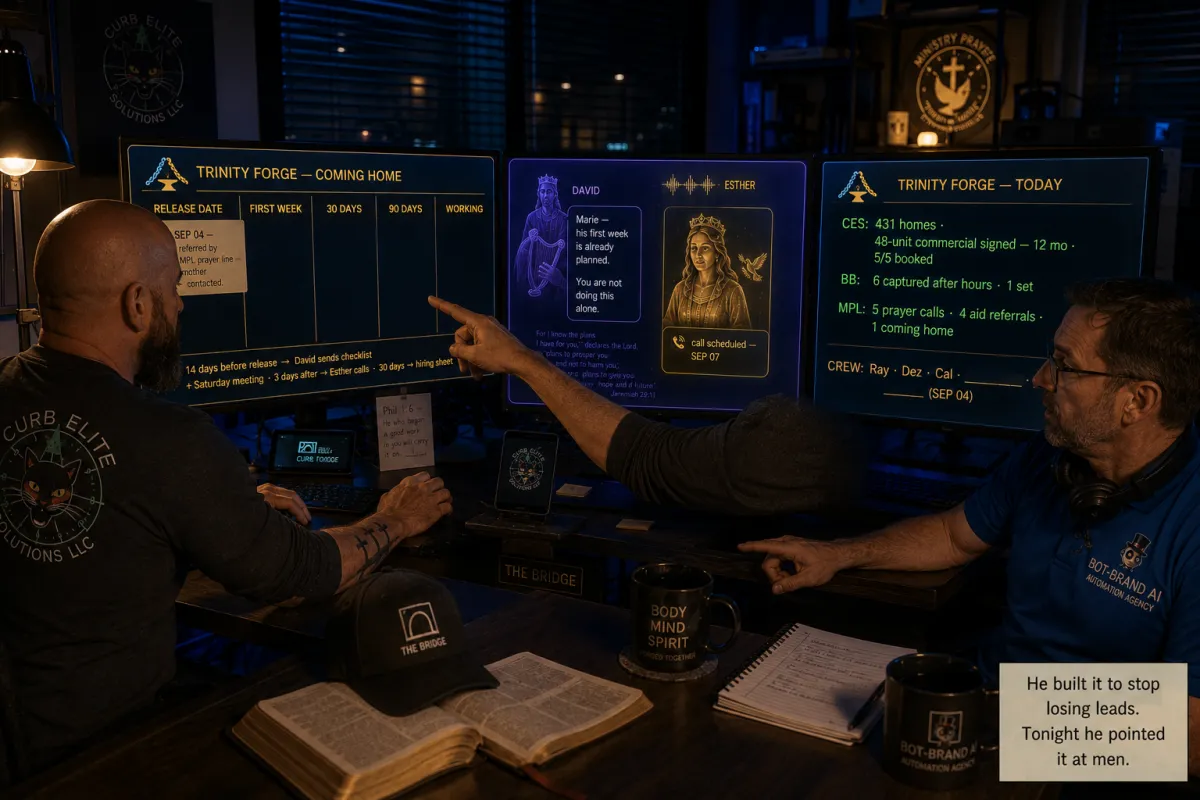
B3C3P6: "Coming Home"
Time: 9:20 PM — Bot-Brand HQ
The thing Matt actually knows how to do — the only real skill under all three companies — is build a pipeline so that nobody falls out of it. A lead comes in, it gets a stage, it gets a next action, and something wakes up and touches it on a schedule whether or not a human being remembers to. He has spent two years perfecting that on strangers who wanted their driveways cleaned. At 9:20 on a Monday night, with a twelve-month commercial contract on the board and three men on payroll, he opened a new one and built the same architecture for a man he has never met who walks out on the fourth of September. Release date. First week. Thirty days. Ninety days. Working. Fourteen days out, David sends the checklist and the Saturday meeting. Three days after the gate, Esther calls — not waits to be called, calls. At thirty days, when the newness is gone and the couch is starting to feel permanent, the hiring sheet goes out. It runs whether Matt is asleep, on a roof, or sitting in a fellowship hall on a Thursday. The machine was never about the leads. The leads just taught him how to build something that doesn't drop people. Dez leaned over and added the one stage Matt hadn't thought of — a check-in at day sixty, "'cause that's the week I almost quit" — and the two of them argued about the wording of a text message for twenty minutes at nine o'clock at night. Somewhere across town, a woman in scrubs read four sentences on her phone before bed and cried in a way that didn't hurt. The fourth line on the crew list is still blank. But it has a date on it now, and everything Matt built is already awake and moving toward it.
Into The Trinity — Book 3,
Chapter 4 : Trinity Forge — Three Made One.
Into the Trinity — "Vendor Four"
Chapter 4 opens on the man who lost. Not a villain, not a punchline — a fifty-eight-year-old exterior contractor at his own kitchen table at ten till seven in the morning, twenty-two years in business, good truck, good work, good name, sitting in front of a phone with eleven unheard voicemails on it because there is no version of a one-man company that answers a phone while it is running four thousand PSI. He is about to listen to the one from nine days ago. He already knows what it is. In Chapter 3 a property manager called four companies on a Sunday night and only one of them was awake. This is what the other end of that sounded like.
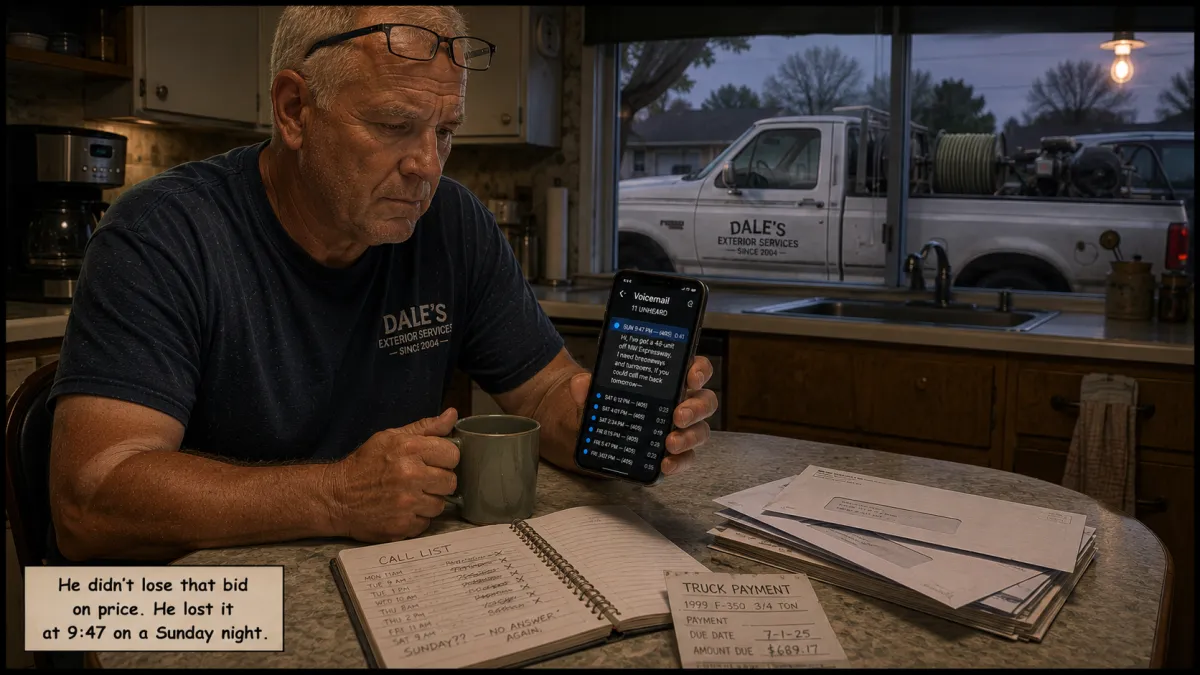
B3C4P1: "Vendor Four"
Time: 6:50 AM — Kitchen Table, South Oklahoma City
Dale has been washing houses in this town since 2004. He does not cut corners, he does not chase, he has never once left a job half-finished, and there are men in three zip codes who will tell you he came back on a Saturday for free to fix something that wasn't his fault. He is also, right now, nine days late listening to the biggest job that has ever tried to reach him — because at 9:47 on a Sunday night he was asleep, and on Monday he was on a roofline in Moore, and on Tuesday there were fourteen more calls, and somewhere in there the woman with the 48 units stopped waiting for him. Nobody outworked Dale. Something out-answered him. That is the whole difference, and it does not feel like a technology problem when it is happening to you — it feels like a bad month, or bad luck, or a town that doesn't value good work anymore. He set the phone face-down without playing the message, drank the coffee cold, and went out to load a truck that will do six hundred dollars today. Eleven other people tried to hand him money this month and he never heard a single one of them ask. In about eleven hours, the man who took that 48-unit contract is going to pull into his gravel yard, and Dale is going to assume it's to gloat.
Into the Trinity — "Vendor Four"
Nine days into the biggest contract Curb Elite has ever held, the machine dies. Not dramatically — no fire, no explosion. A metallic bark, a shudder, a wand that goes limp in a man's hands, and a very expensive silence. Two men standing on a breezeway at 9:05 in the morning with four units due, a route in Edmond due after lunch, and payroll due Friday. This chapter's engine is not the weather. It's a seized pump and a bank balance.
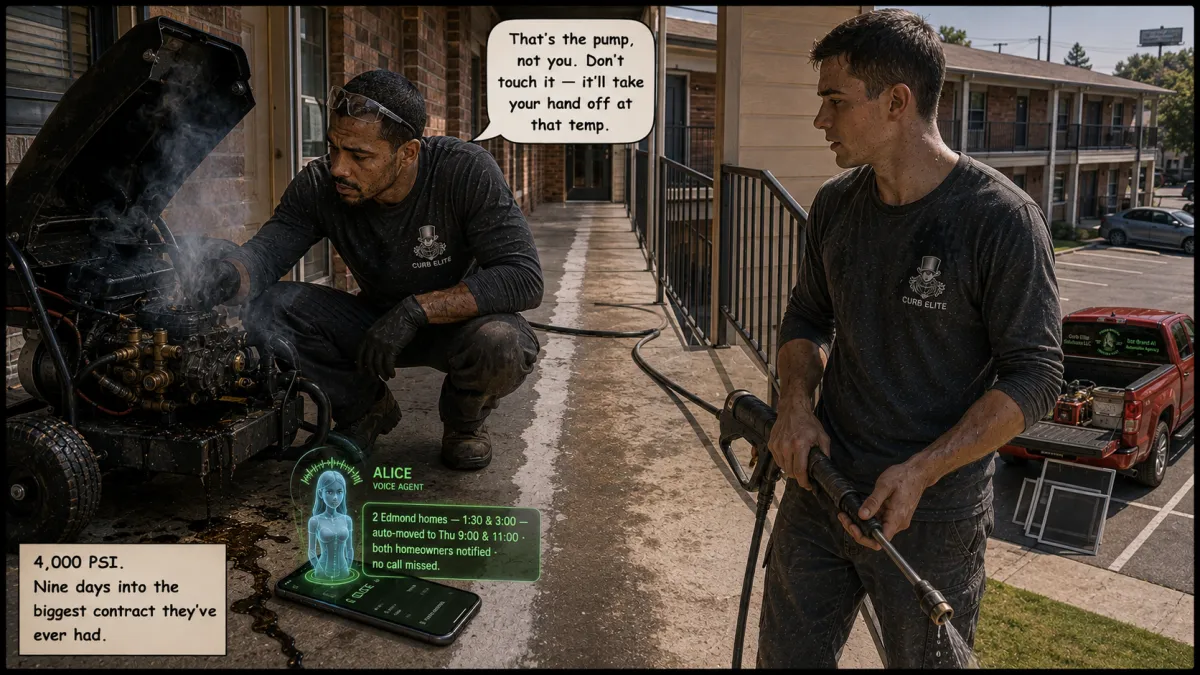
B3C4P2: "The Pump"
Time: 9:05 AM — 48-Unit Apartment Community, Northwest OKC
It went in about a second and a half. The unloader had been chattering for two days — Ray said something about it Friday and Matt said after the turnovers, and both of them were right and both of them were wrong. Now there is a seized pump smoking on a second-floor breezeway, four thousand dollars of replacement sitting between them and any pressure washing at all, two Edmond houses on the afternoon board, a 48-unit commercial contract nine days old that Matt talked his way into by promising documentation, and three men on a W-2 payroll that runs Friday whether or not a machine works. Cal's first reaction was that he broke it, because that is what nine days of not-yet-believing-it does to a man. Ray's first reaction was to put the back of his wrist near the housing, tell him it wasn't him, and reach for his phone — because the actual emergency wasn't the pump. The actual emergency was two homeowners in Edmond expecting a truck at 1:30, and by the time Ray got his phone up, Alice had already moved them both to Thursday morning, texted both homeowners, and offered both a window. Zero missed calls. Zero angry customers. One dead machine. That is a bad morning instead of a catastrophe, and the difference between those two things cost him nothing today because he paid for it two years ago.
Into the Trinity — "Vendor Four"
The pivot. No machine means no exterior — so the whole day rotates onto the part of the contract nobody thought about when it was signed: the turnover units. Junk removal and property cleanouts, by hand, up and down a stairwell, in August. This is the chapter's scripture beat, and it does not come from a pulpit, a truck door, or a folding chair. It comes out of a man's mouth halfway down a stairwell with a dead tenant's mattress on his back, it comes from the newest guy, and nobody makes a thing out of it.
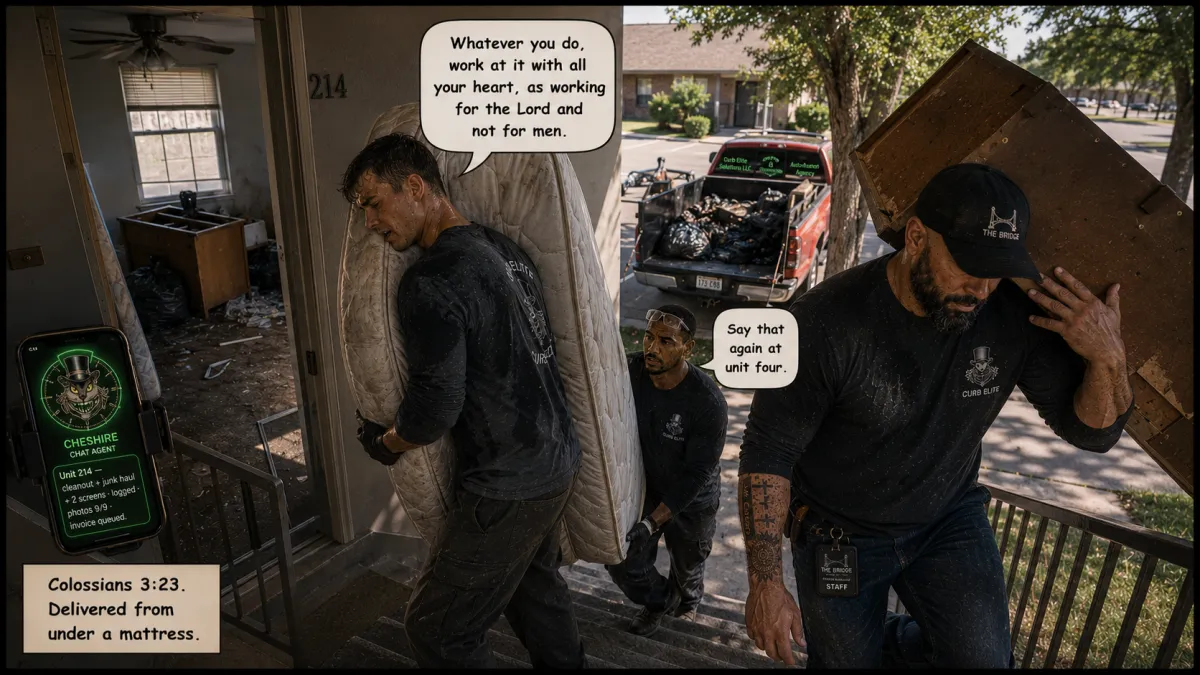
B3C4P3: "Whatever You Do"
Time: 10:20 AM — Turnover Unit 214, Northwest OKC
Here is the part that only looks like luck. The contract Matt signed nine days ago was not just breezeways — it was quarterly exterior and every turnover cleanout, junk hauled, screens repaired and replaced as they come. He wrote it that way because a property manager with three vacant units bleeding rent will always have three more next quarter, and recurring beats seasonal every year of your life. So when the pump seized at 9:05, the day did not stop. It rotated. Four units of cleanout and junk removal do not care whether a pressure washer runs, and by 10:20 there were three men on a stairwell doing the oldest, dumbest, most honest work there is: carrying somebody else's abandoned life down two flights in August. A company that only sells one service dies the day one machine does. Somewhere in the middle of it, with a mattress on his back and no air left in him, Cal said the verse he memorized in a place he does not talk about, because it was the only thing he had for a long time and it still runs in his head when the work gets stupid. He wasn't preaching. He was breathing. Ray told him to save it for unit four. Matt went up the stairs past both of them with a dresser on his shoulder and did not say one word about it, because the fastest way to kill a thing like that is to turn it into a moment.
Into the Trinity — "Vendor Four"
Noon, and the money. This is the panel where the story stops being about grit and starts being about plumbing. A man who three years ago would have limped a broken machine for six weeks is standing in an equipment lot with a four-thousand-dollar decision, and the reason he can make it today is not faith, courage, or a windfall. It's that an invoice went out at 11:14 this morning without a human touching it and got paid at 11:52.
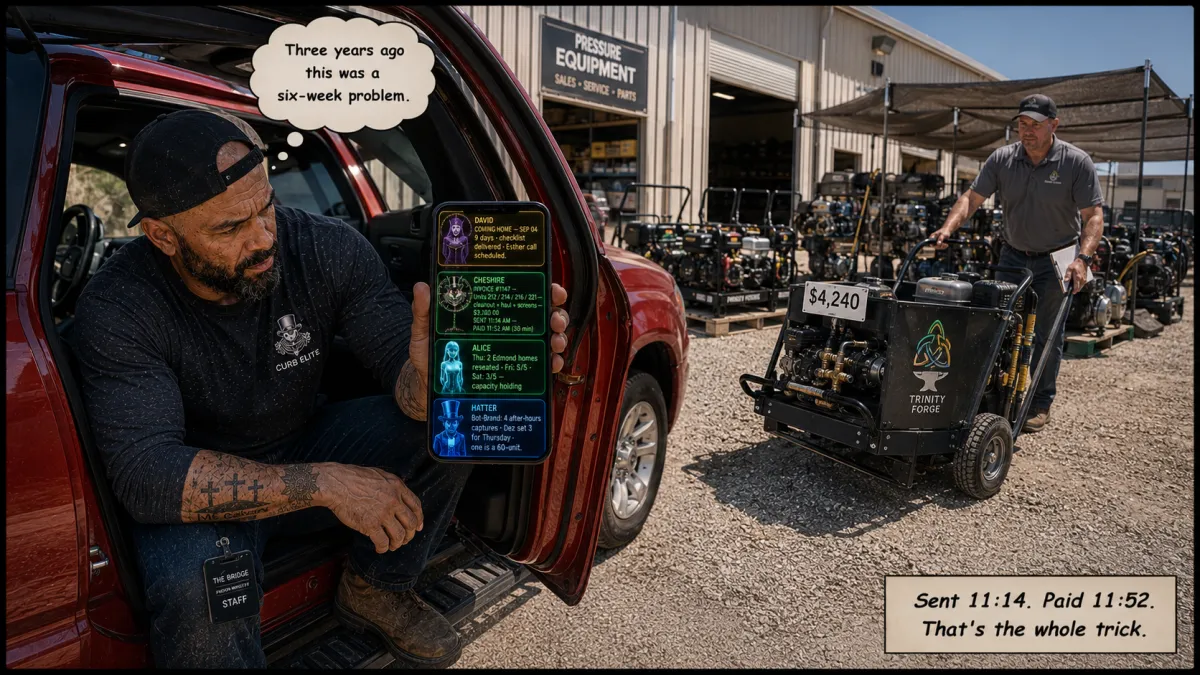
B3C4P4: "Paid at 11:52"
Time: 12:40 PM — Equipment Dealer Lot, Northwest OKC
There is a version of this Wednesday that everybody who has ever run a truck knows by heart. The pump dies, you can't cover the replacement, so you rent a junk unit for two weeks, then you limp a rebuilt one for a month, then you miss the second visit on the contract you just signed and lose it, and eight months later you're telling people the commercial work "wasn't worth it." Matt has lived that version. What makes today different is not that he had four thousand dollars sitting around — he didn't, and payroll for three men runs Friday. What makes today different is that the four units they emptied this morning were photographed, logged, and invoiced by Cheshire at 11:14 while the trailer was still being loaded, the property manager tapped a link on her phone over lunch, and $3,180 hit the account at 11:52 on the same day the work happened. Cash flow is not a character trait. It's a system. Nobody had to remember to bill it. Nobody had to "get around to invoicing this weekend." Nobody had to make an awkward call in three weeks about a statement that got buried on somebody's desk. The machine that catches leads at 9:47 on a Sunday is the same machine that turns finished work into money before lunch — and on a Wednesday when a pump seizes, those thirty-eight minutes are the entire difference between a company that grows and a company that stalls out and blames the market. He bought the unit. He stuck a Trinity Forge decal on the frame in the parking lot. Then he pulled out his phone and looked up an address in south Oklahoma City.
Into the Trinity — "Vendor Four"
Late afternoon, a gravel yard, two trucks, and the least likely sales call in the book. Matt is not here to take Dale's accounts, and Dale does not believe that for a full ninety seconds. This is the conversion panel and it does not feature a homeowner — it features the competitor, because the thing Bot-Brand actually sells is the exact advantage that beat him. Nobody cold-called anybody. Matt drove to a man he had taken a job from and told him the truth about how.
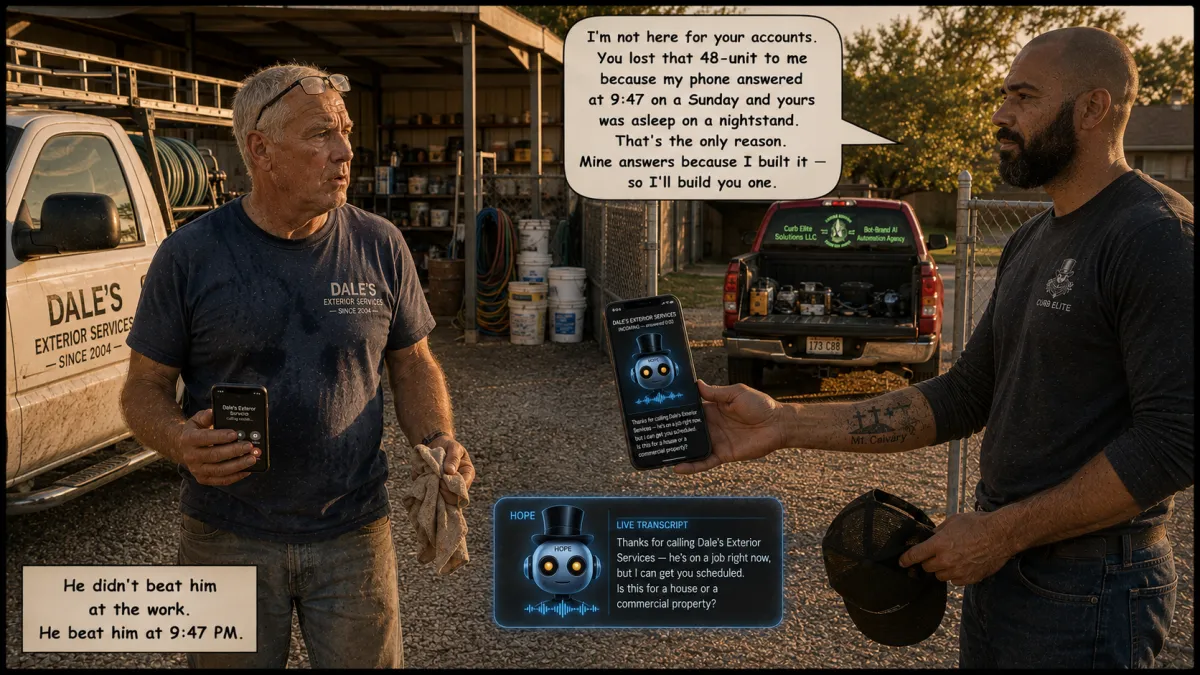
B3C4P5: "I'll Build You One"
Time: 5:45 PM — Dale's Yard, South Oklahoma City
The easy thing was to say nothing. Dale is not a friend, he is the guy whose bid Matt took, and there is a whole industry built on letting a competitor keep losing quietly. But Matt has sat exactly where Dale is sitting — in a truck at the end of a fourteen-hour day with a phone full of people who tried to hand him money while both his hands were full — and he did not get out of that by outworking it. Nobody gets out of that by outworking it. So he drove to a gravel yard in south OKC at a quarter to six, took his cap off, and told a fifty-eight-year-old man the actual reason he lost: not price, not quality, not luck — availability. Then he did the only thing that has ever closed a service-business owner, which is nothing at all. He handed him a phone and told him to call his own number. Three rings. Somebody answered. Dale stood in his own yard and listened to his own business greet a customer, ask whether it was residential or commercial, and offer two appointment windows, and the rag came out of his hand and he never noticed it hit the gravel. He asked what it costs. Matt told him, plainly, no theatrics, and told him Dez would call in the morning to walk it through and get his service list and his hours right — because Dez is better on the phone than Matt is and Matt has stopped pretending otherwise. The best sales call Bot-Brand made all week was made in person, to a man who had every reason to close a gate on it. Dale said he'd think about it. Then, before Matt made it back to the truck, he said: "No. Call me in the morning."
Into the Trinity — "Vendor Four"
Dusk, and the closing panel is not a dashboard, not a shop bay, and not a man alone with his thoughts. It's a courtyard full of people who live there. Somebody is grilling. Kids are riding bikes across concrete that is a different color than it was last week. And the meaning of the whole chapter arrives in the smallest possible form: a stranger on a second-floor landing calls one of Matt's men by his first name.
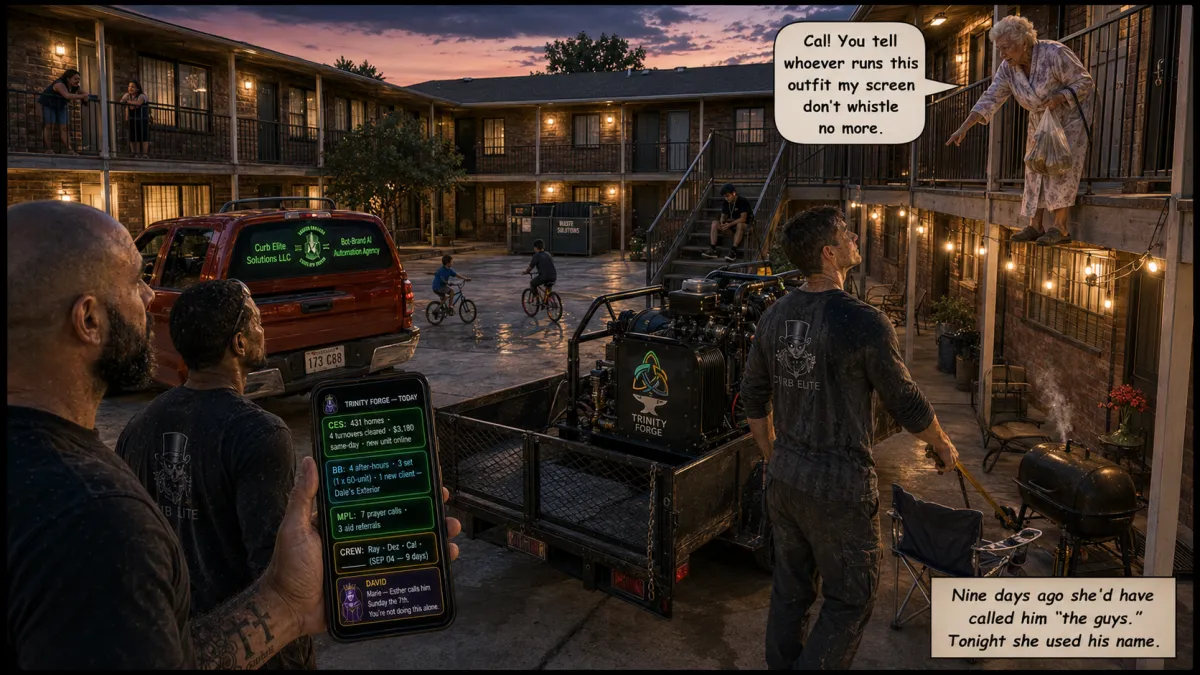
B3C4P6: "Nine Days"
Time: 8:15 PM — Courtyard, 48-Unit Apartment Community
Ninety-six timestamped photographs, a per-technician job history, a general liability certificate, workers' comp, a W-2 stub — Matt built every bit of that so a property manager with a corporate policy could say yes to men she would otherwise never be permitted to let onto her property. All of it was necessary. None of it is what happened tonight. What happened tonight is that a woman in a housecoat with a sack of groceries leaned over a second-floor railing and hollered a man's first name across a courtyard to thank him for a window screen that doesn't whistle anymore. She did not know his record and she was never going to. She knew his name because he carried her bags up on Monday while a unit was drying, and because the breezeway she has walked for nine years is a color she had forgotten it was. That is the only credential that ever actually restores anybody, and no system on earth can manufacture it. A machine can invoice at 11:14, reseat two Edmond homes without dropping a call, answer a phone at 9:47 on a Sunday night, and text a mother in scrubs that she is not doing this alone. It cannot make a stranger learn your name. All it can do is hold the day together long enough for a man to still be standing there when it happens. The pump seized this morning. The contract held, the crew ate, a competitor got a phone that answers, and nine days from now there is a fourth line on a list waiting on a gate somewhere to open. Cal finished the strap, said "yes ma'am," and rode all the way back to the shop without saying anything else at all.
Into The Trinity — Book 3,
Chapter 5 : Trinity Forge — Three Made One.
Into the Trinity — "Declined By Vendor"
Chapter 5 opens inside somebody's home. Not a job site, not a truck, not a screen — a ground-floor one-bedroom at a sixty-unit complex off SE 44th at half past six in the morning, where a woman is standing on a closed toilet lid photographing a bathroom ceiling for the fourteenth time in five months. Nobody in this frame has ever heard of Curb Elite Solutions. Nobody in this frame is going to appear in the business part of this chapter at all. She is here because in about four hours a man is going to offer Matt nine thousand six hundred dollars in cash to make the outside of this building look good enough to pass a lender's walkthrough, and the reader needs to have already stood in her bathroom before that offer gets made.
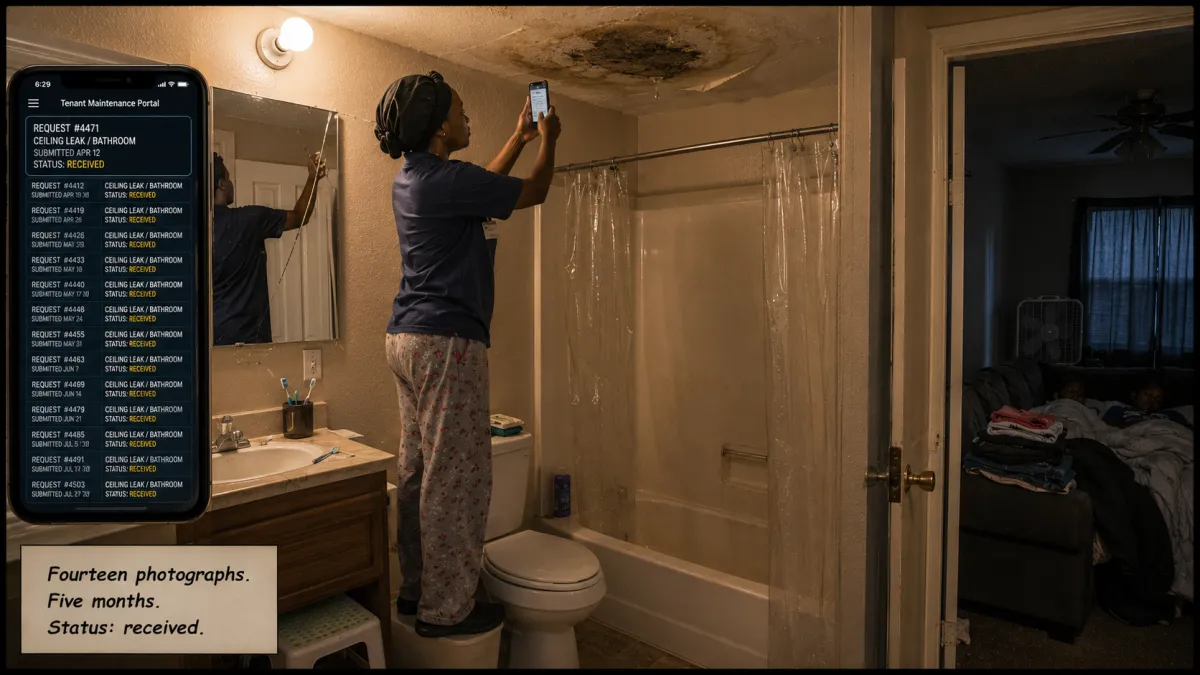
B3C5P1: "Status: Received"
Time: 6:30 AM — Unit 118, Sixty-Unit Complex, Southeast Oklahoma City
Her name is on a lease that renews in November and she has never once been late on it. The ceiling started in April as a soft spot the size of a hand. It is now the size of a dinner plate, it drips when the unit above her runs a shower, and there is a smell in the bedroom she has stopped being able to un-smell. She has submitted fourteen tickets. Every one of them says RECEIVED. Nobody has ever knocked. The management company that owns this building is not incompetent — it is busy, and it is busy with something else entirely. In eleven days a lender is walking this property as part of a refinance, and there is a number on a spreadsheet in a different city that depends on what that lender sees. What the lender sees is the parking lot, the breezeways, the siding, the dumpster pad, and the front elevation off the street. What the lender does not see is Unit 118's bathroom ceiling. So the money is going where the eyes are going. In four hours a regional manager in a quarter-zip is going to stand in that parking lot and offer Matt Maycumber nine thousand six hundred dollars in cash to wash the parts a lender can see, quietly, this week, with no paperwork attached to it. He is going to make it sound like the easiest money Curb Elite has ever been handed. And in a way that is exactly what it is.
Into the Trinity — "Declined By Vendor"
Ten-fifteen, and the biggest lead on the Bot-Brand board finally becomes a real place with a real man standing in it. This is the walkthrough that Dez set last Thursday, the one everybody was excited about — sixty units, quarterly exterior, common areas, the largest recurring number anybody at Trinity Forge has ever said out loud. And it takes about six minutes for Matt to understand that he is not being hired. He is being rented as a coat of paint.
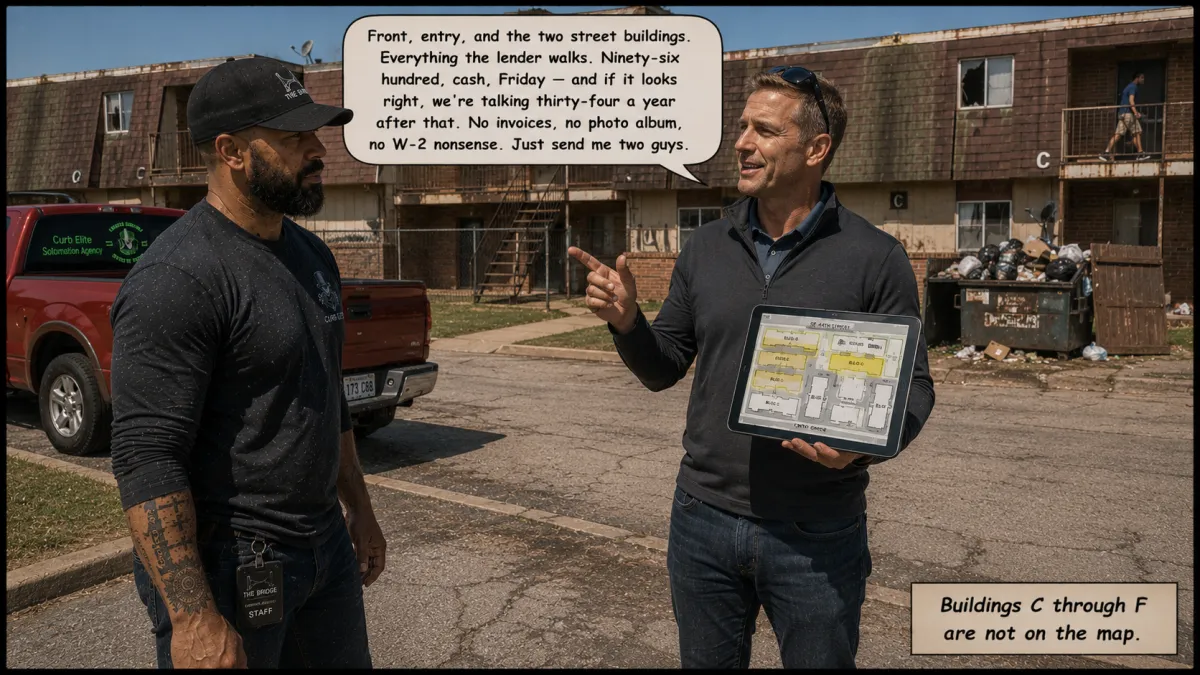
B3C5P2: "The Yellow Half"
Time: 10:15 AM — Sixty-Unit Complex, Southeast Oklahoma City*
It came in at 9:47 on a Sunday the way all of them do now — Hope caught it after hours, Dez called Thursday morning, and by Thursday afternoon it was the gold card at the top of the board: 60 units, recurring, largest lead in company history. Ray asked about it twice. Cal did the math on what a second truck would cost. Matt drove down there Tuesday morning with a folder he never opened, because six minutes into the walk, Vance turned his tablet around and the whole thing came into focus at once. Half the property is highlighted. The other half is not. He does not want sixty units power washed. He wants the four surfaces a lender's eyes will land on to look washed, this week, before a refinance closes, and he wants it done by two guys who were never there, paid in cash on a Friday, with no invoice, no photographs, no record, and no employees attached to it. Thirty-four thousand a year is dangling behind it like a carrot on a stick, and Matt has been in business long enough to know that carrot is not real — it is the thing you say to a vendor to get him to do the cash job. And standing there in that lot, Matt did the arithmetic that nobody who has not run a truck ever has to do: nine thousand six hundred dollars is eleven weeks of payroll for three men. It is the second machine. It is the trailer. It is also a job where his men do not exist.
Into the Trinity — "Declined By Vendor"
Eleven-oh-five. The panel where he says no, and the reason he gives is not the reason anybody expects. He does not lecture Vance about the tenants. He does not talk about God, or ethics, or the mold. He gives the one reason that is unanswerable and completely practical, and it takes eleven seconds. Then he walks to his truck and creates a status in his own system that has never existed before, because until today he never needed it.
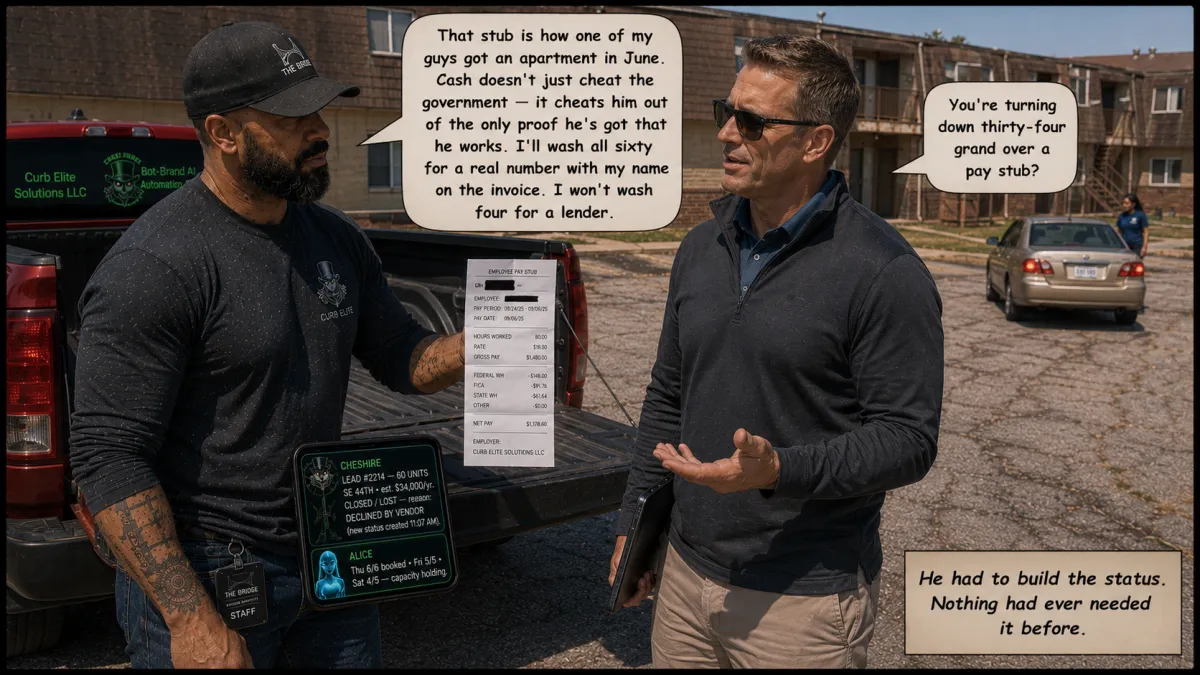
B3C5P3: "Declined By Vendor"
Time: 11:05 AM — Sixty-Unit Complex, Southeast Oklahoma City
Here is what makes this hard, and any man who has run a service business will tell you the same: it was not a hard decision. It was a hard afternoon. The decision took eleven seconds and Matt never raised his voice for a syllable of it. He did not tell Vance about the ceiling in 118, because Vance already knows about the ceiling in 118 and a lecture would have cost Matt the moral high ground and the contract both. He told him the truth that actually applies to Curb Elite Solutions: his men get paid on a W-2 because a pay stub is the only document in America that will rent one of them an apartment, and the entire reason a property manager off NW Expressway let three men with records onto her property in Chapter Three is that every hour any of them has ever worked is written down somewhere with a real company's name on it. Cash work erases that. One Friday envelope, and a man who is trying to prove he exists gets a week of his life that never happened. There is no amount of money that is worth handing a man an unpaid week, and there is definitely no amount of money worth becoming the vendor who helps a building pass a walkthrough it should fail. So he said no, shook the man's hand, got in the truck, and sat in the driver's seat for a second with his phone. Cheshire had eleven closing reasons on file — price, timing, no answer, went with competitor, six others. Not one of them fit. Matt typed a twelfth one himself at 11:07 in the morning in a parking lot: DECLINED BY VENDOR. Then he drove out of the lot past a rusted railing and an overflowing dumpster with thirty-four thousand dollars a year in his rearview mirror and absolutely no idea yet whether he had just done the right thing or the expensive thing.
Into the Trinity — "Declined By Vendor"
Three-twenty in the afternoon, a gas station lot, and the loneliest hour in any owner's week: the one after you turn down money. This is the scripture beat and it does not happen in a fellowship hall, a truck cab conversation, or a stairwell. It happens on a phone call — and the man on the call is Matt, and the line he calls is the one he built. He does not call a pastor. He does not call his wife. He half-embarrassedly dials Ministry Prayer Life like any stranger would, and Esther answers on the second ring and does not know or care that he owns her.
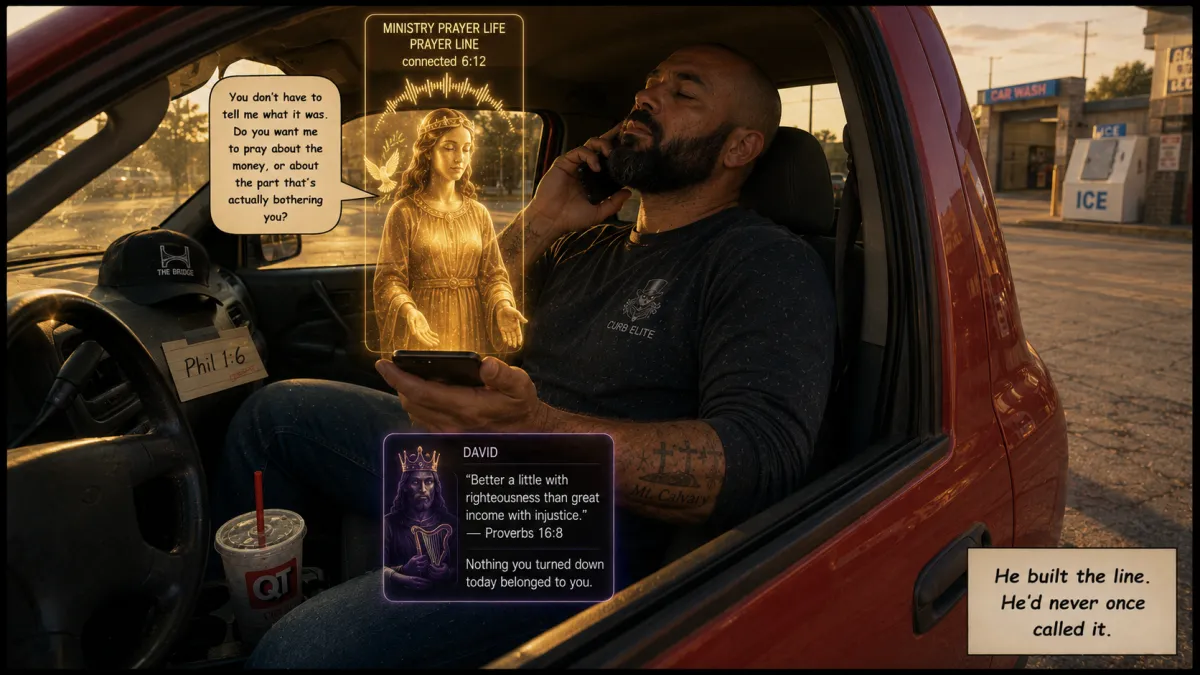
B3C5P4: "Better A Little"
Time: 3:20 PM — Gas Station Lot, South Oklahoma City
There is a particular kind of doubt that arrives about four hours after you do something right, and it does not sound like temptation. It sounds like responsibility. Three men are on that payroll. Ray has a daughter. Cal just signed a lease in July on the strength of a pay stub. You had thirty-four thousand dollars a year in your hand and you handed it back because you didn't like a man's tablet. Matt sat in a gas station lot with that running on a loop and did the thing he has told two hundred other men to do and had never once done himself: he called the prayer line. Not a friend. Not a board member. The thing he built, at three in the afternoon, like a stranger. Esther answered on the second ring, asked no qualifying questions, took no name, and offered him the only good question in the whole conversation — whether he wanted her to pray about the money or about the part that was actually bothering him. It was not the money. It was that a woman he will never meet is going to keep photographing her ceiling on the way to work, and washing four buildings would not have fixed that, and refusing to wash them does not fix it either, and there is no version of this Tuesday where Matt gets to be the hero of it. She prayed for six minutes. She did not tell him he did the right thing, because she is not built to flatter. Then David sent four words of Proverbs and one sentence that did more work than any of the four hours had: *nothing you turned down today belonged to you.* The ministry he stood up to catch other people caught him at 3:20 on a Tuesday, and did not know it was him. He put the truck in gear and went to work.
Into the Trinity — "Declined By Vendor"
Ten to six, and the answer to the question Matt could not answer at three o'clock arrives from the least likely desk in the building. Dez has been on the phone since eight in the morning and has no idea any of the day's drama happened. This is the conversion panel: while Matt was losing a contract, the free-world hire on the follow-up line was quietly booking three appointments for Thursday worth more than the one that walked — and Dale's phone, live since Monday, is ringing itself into a booked job in the background.
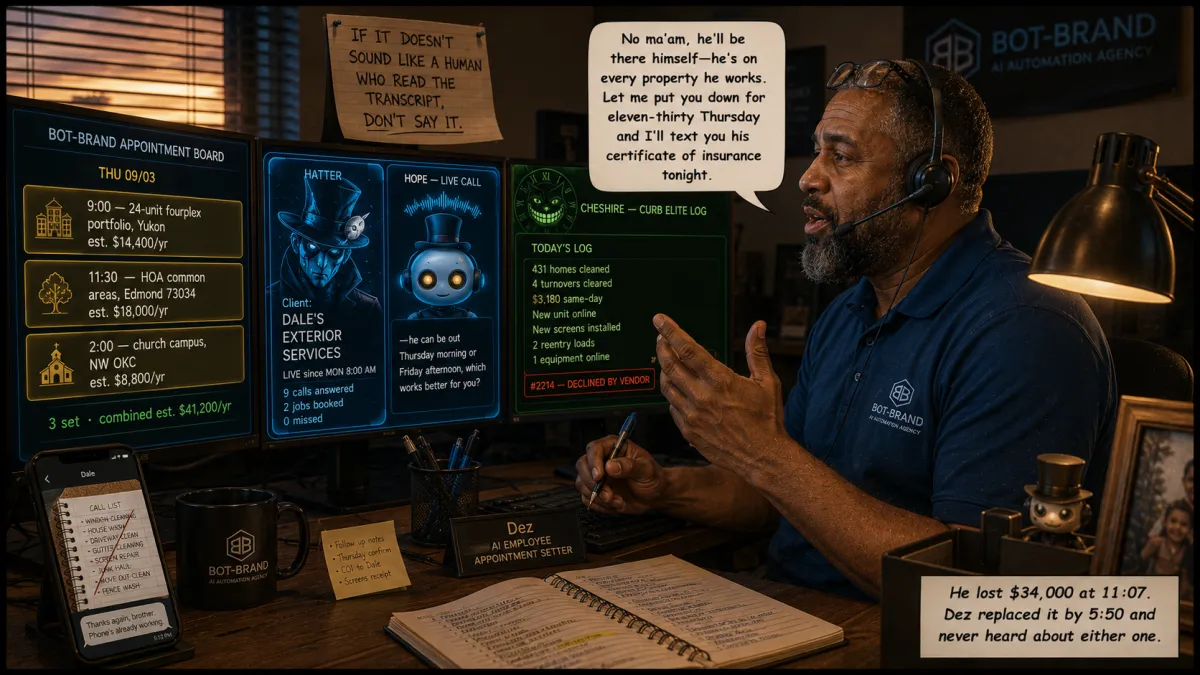
B3C5P5: "Forty-One Two"
Time: 5:50 PM — Bot-Brand HQ
This is the part nobody puts on a motivational poster, and it is the entire reason Matt could afford to be a man with standards this morning: integrity is a lot cheaper when your calendar is full. Three years ago a nine-thousand-six-hundred-dollar cash job on a Friday would not have been an ethical question. It would have been a rent question, and Matt is not going to pretend he would have gotten it right. What changed is not his character. What changed is that a voice agent answers a Bot-Brand line at 9:47 on a Sunday night, an appointment setter out of the free world calls those people back at eight the next morning sounding like a human being who actually read the transcript, and by Tuesday evening there are three seated appointments on Thursday worth forty-one thousand two hundred a year — booked by a man who was in a state facility fourteen months ago and who, at 5:50 PM, still has no idea that his boss turned down a contract or sat in a gas station lot about it. Dez is not managing Matt's conscience. He is doing his job. And in the next tile over, a twenty-two-year contractor Matt could have quietly let keep losing has had a phone that answers since eight o'clock Monday morning — nine calls, two jobs booked, zero missed — and Dale's way of saying thank you was to text Dez a photograph of a notebook page with one line drawn through it. That was his call-back list. It's empty. He doesn't need it anymore. Somewhere in there is the whole thesis of Trinity Forge and it is not a spiritual claim, it is an operational one: build the thing that never sleeps, and you get to be the kind of man who can say no at 11:07 in the morning.
Into the Trinity — "Declined By Vendor"
Seven-thirty at night, a long picnic table under string lights behind a barbecue joint, and six people who three months ago had no reason to ever be at the same table. Two field hires, an appointment setter, a mother in scrubs who came off the prayer line, and a fifty-eight-year-old competitor Matt beat and then built a phone for. Nobody toasts anything. Nobody makes a speech. There is a seventh place set at the empty end and everybody there knows what Friday is.
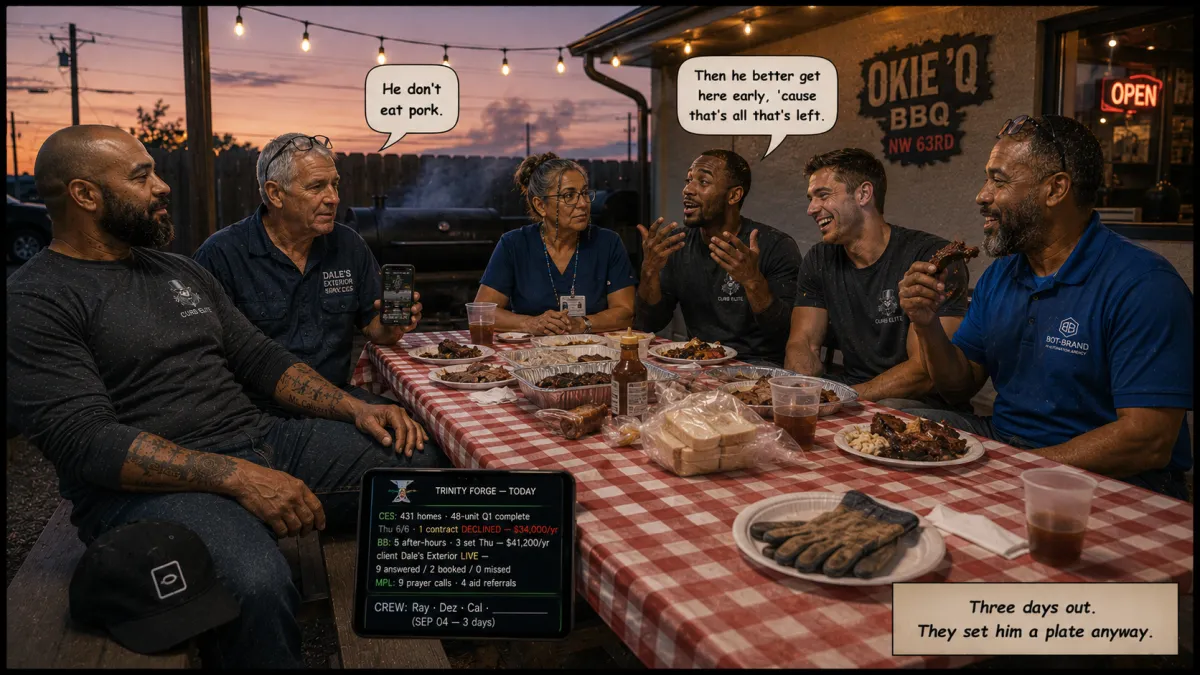
B3C5P6: "A Plate At The End"
Time: 7:30 PM — Back Patio, Barbecue Joint on NW 63rd
Count the table. A man twelve weeks out of a facility, teaching. A man five weeks out, laughing for the first time since anybody met him. A man fourteen months out, who booked forty-one thousand dollars of work today off a headset. A woman in scrubs who called a prayer line in a parking lot in July because she was terrified of a date on a state letter, sitting at a table with the people who are going to be standing on the other side of that date. A fifty-eight-year-old exterior contractor who lost the biggest bid of his life to the man sitting next to him, and who now has a business phone that answers at nine o'clock at night, holding it face-up on the table like it might do something interesting. And Matt, who lost thirty-four thousand dollars a year at 11:07 this morning and has not mentioned it once. Nobody at that table is a client, a case, an outcome, or a line item. They're just eating. That is what Trinity Forge is actually for, and it is worth saying plainly because the machinery is easy to mistake for the point: the voice agents, the pipelines, the same-day invoices, the timestamped photographs, the vendor packet, the dashboard glowing on a bench under a picnic table — none of that is the company. All of it exists to hold a week together tightly enough that on a Tuesday night in September six people who had no business knowing each other can sit down at a folding table with a strand of bulbs over it and argue about brisket. There is a seventh plate at the empty end with a new pair of gloves on it. Nobody made a ceremony out of setting it. Friday morning a gate is going to open two hours north of here, and Marie is going to be in a Corolla in the parking lot, and there is a chair, a plate, a shirt in a box in Matt's truck, and a line on a crew list waiting on a name. **The rest of it — the four buildings, the yellow half of the map, the ninety-six hundred cash — was never going to fit at this table anyway.
Ready to grow with Bot-Brand?
Deploy high-performance infrastructure, autonomous CRM logic, and AI-driven tools engineered to eliminate lead leakage and scale your operational capacity.
Schedule Architectural Audit

Disclaimer: Bot-Brand does not claim specific clients, appointments, or revenue outcomes. All services are provided as Professional Technical Infrastructure on a best-effort basis according to the selected package and agreed scope of work.
Full Disclaimer© 2026 Bot-Brand. All rights reserved.
Curb Elite Solutions LLC · DBA Bot-Brand · Oklahoma City, OK