AI Chatbots vs Operational AI: Key Business Insights
AI Automation, Business Operations, Chatbots
The Difference Between “Answering” Chatbots and Operational AI — And Why It Matters by Morning
Most businesses say they “have AI” because there’s a chatbot on their site. But there is a sharp line between a bot that answers questions and an AI system that is wired into your operations. Understanding that line is the difference between a slightly nicer FAQ and a 24/7 autonomous revenue engine.
Two Very Different Things Hiding Under the Word “Chatbot”
For high-volume local service businesses and enterprises, “chatbot” can mean one of two completely different architectures:
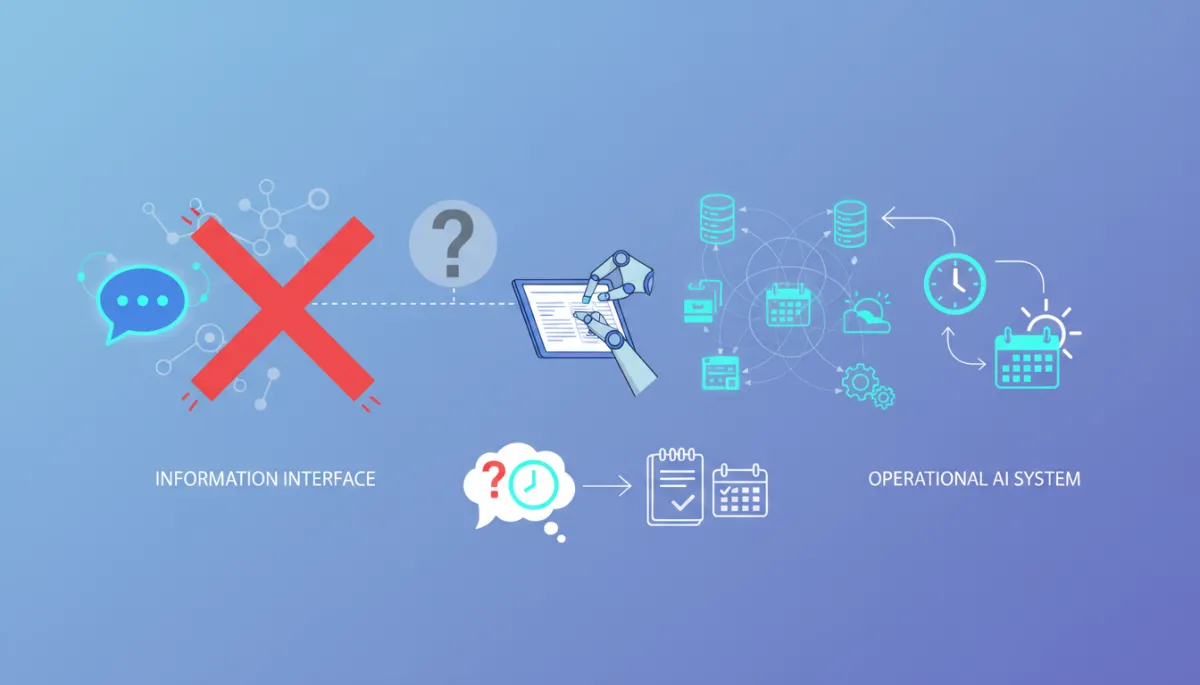
An answering chatbot — an intelligent information interface that responds to questions, explains policies, and guides visitors with natural language.
An operational AI system — a connected agent that talks, decides, and then writes itself into your business: calendars, CRMs, pipelines, tickets, and workflows.
Bot-Brand builds the second category: autonomous business ecosystems that intercept, qualify, and synchronize leads with zero human intervention. To see why this distinction matters, we have to be honest about the hard ceiling of the first category — and why that ceiling is not a “failure of AI,” but a design choice.
The Hard Ceiling of Answer-Only Chatbots
Answering chatbots are often impressive. They can explain your services, quote your opening hours, and even handle complex FAQs with human-grade inflection. But they all share the same structural limitation:
📌 Key Reality: When the conversation ends, nothing in the business has changed unless a human takes action afterward.
That limitation shows up in a few predictable ways:
No durable record: The conversation may exist in a chat log, but it is not a structured lead, ticket, or opportunity inside your systems.
No scheduling: The bot can say, “We’re available Monday–Friday,” but it cannot reserve a real slot on a real calendar that your team trusts.
No workflow trigger: No follow-up sequences, task assignments, or escalations are reliably fired from the interaction itself.
Human intervention still required: Someone must read, interpret, and manually re-enter what happened into your CRM, calendar, or job system.
In other words, the bot is a smart information interface. That is not a defect. It is exactly what it was designed to be: a conversational front-end to your knowledge, not to your operations. It helps people understand; it does not help your business execute.
Why This Is an Information Interface, Not “Bad AI”
It is tempting to blame the AI when a chatbot “doesn’t change anything.” But the issue is architectural, not intellectual. The system was never connected to the places where your business actually lives: calendars, payment processors, dispatch tools, EMR, job management, or your CRM.
Think of it like a highly skilled receptionist who is forbidden from touching a keyboard. They can answer every question perfectly, but they cannot:
Log a new patient
Book a service call
Open a ticket or assign a technician
They are doing their job: communicating information. The same is true of a pure Q&A chatbot. It is not failing as AI; it is succeeding as an information surface. The problem, for growth-minded operators, is that information surfaces do not remove manual bottlenecks. They just make those bottlenecks slightly better informed.
What Operational AI Does Differently Inside Your Business
An operational AI system — the kind Bot-Brand engineers — still answers questions, but that is the smallest, least interesting part of its job. Its real mandate is to change the state of your business every time it interacts with a human.
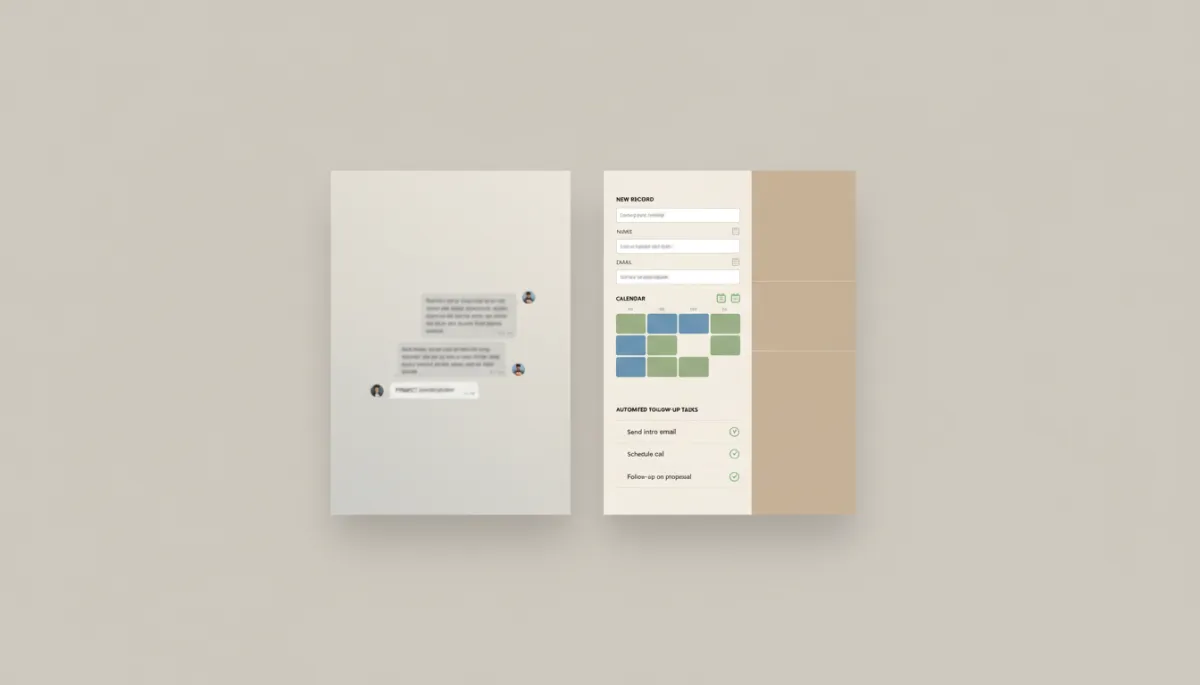
Operational AI turns conversations into booked slots, structured records, and triggered workflows.
Concretely, that means:
Records are written, not just read. Every qualified interaction becomes a structured entity in your CRM, booking system, EMR, or job platform — with fields, tags, and source attribution aligned to your existing architecture.
Qualifying questions are asked on purpose. The AI follows a logic tree (what Bot-Brand calls the Neural Intercept Protocol) to capture budget, location, urgency, service type, and any compliance-critical data before it attempts to book or escalate.
Appointments are scheduled against real availability. The system reads your calendars or booking infrastructure, respects rules (drive time, staff skills, blackout periods), and reserves actual slots that your team sees and trusts.
Follow-ups are automated. No more “We’ll call you back tomorrow” that never happens. The AI triggers SMS, email, or voice follow-ups on precise timelines, with context-aware messaging tied to what the person already said.
Out-of-scope issues are escalated with context attached. When the AI hits a boundary condition — legal risk, medical nuance, complex pricing — it routes the case to a human with the entire conversation transcript, structured notes, and suggested next actions.
💡 Pro Tip: If your AI can’t create, update, or trigger anything in your core systems, it’s still just an interface, no matter how “smart” it sounds.
The One-Question Test: What Exists in the Morning?
There is a simple, brutal way to evaluate any “AI” in your business — whether it’s a website chatbot, a voice agent, or an SMS assistant:
When the conversation ends at 11 PM, what exists in the morning?
If the answer is:
“A chat transcript in some inbox that someone might read” — you have an answering interface.
“A booked appointment on the calendar, a new contact in the CRM, tags applied, a task assigned, and a follow-up sequence scheduled” — you have an operational AI system.
That one question cuts through demos, buzzwords, and UI polish. Either the AI is writing itself into your operations while you sleep, or it is entertaining people and leaving you with more to do in the morning.
The Tradeoffs: Why Operational AI Demands Real Decisions
Moving from answer-only chatbots to operational AI is not just a technology upgrade. It is an organizational decision. When Bot-Brand deploys a fully autonomous ecosystem, we always surface the same truth: your business logic lives in people’s heads.
To let AI act, you must externalize that logic into rules, constraints, and priorities, such as:
Which leads are “urgent” versus “tomorrow is fine”?
What kinds of jobs can be double-booked, and which cannot under any circumstances?
What discounts are allowed without approval, and which require a manager?
Which phrases or conditions must always trigger escalation to a human?
For many organizations, this is the hardest part. Writing down these decisions exposes inconsistencies, exceptions, and “it depends” logic that has been managed informally for years. But this is also where the leverage comes from. Once those rules are explicit, AI can apply them at machine speed, 24/7, with perfect recall.
⚠️ Honest Tradeoff: Operational AI forces you to define how your business actually works. The short-term effort is real; the long-term payoff is autonomy.
The reward for doing this work is alignment with Bot-Brand’s core promise: 24/7 autonomous operational infrastructure that intercepts, qualifies, and synchronizes leads with zero human intervention. Once the logic is encoded, your “Neural Intercept” layer can handle the entire top of the funnel and a large portion of mid-funnel operations without waking anyone up.
From Chatting to Changing: Choosing Your Next Step
If you already have a chatbot, you do not need to rip it out tomorrow. But you should be clear-eyed about what it is actually doing. It is an information interface. It reduces friction and answers questions, but it does not create booked revenue, synchronized records, or high-velocity operational scaling on its own.
The next step is to decide where you want AI to change state in your business:
Intercept every inbound lead and qualify it before your team ever sees it
Auto-book high-intent prospects into real calendar slots within defined rules
Recover abandoned inquiries with intelligent follow-ups that run without supervision
Escalate edge cases to your team with the full conversation attached, so humans only handle high-value decisions
That is the shift from “We have a chatbot” to “We have an autonomous operational layer.” It is the shift from answering to executing — and from hoping someone follows up in the morning to knowing the system already has.
Initialize a Secure Uplink to See What Could Exist by Morning
If you are serious about removing manual bottlenecks and building absolute digital autonomy into your operations, the next move is straightforward: evaluate your current systems with the 11 PM test, then design the architecture where AI is allowed to write, not just talk.
Bot-Brand specializes in that transition. Our Architectural Audit and Systems Diagnostic maps how leads currently flow, where decisions live in people’s heads, and how our Neural Intercept Protocol can be deployed to handle the entire top funnel with technical precision and real-world constraints.
If you want your business to wake up to booked appointments, synchronized records, and automated follow-ups — not just chat transcripts — it is time to move beyond answer-only bots.
Next Step: Initialize a Secure Uplink for an Architectural Audit and Systems Diagnostic, and see exactly what your AI could be building for you by tomorrow morning.