
Boost Sales with Fast, Accurate Quote Management
Quote Management, Pricing Strategy, Sales Process
Quotes Lost on Speed Get Misfiled as Quotes Lost on Price
When prospects tell you a competitor “came in cheaper,” they are often really saying, “they got me a complete estimate first.” In high-volume service environments, quote management is less about clever pricing strategy and more about how quickly you can assemble a complete, credible estimate without sacrificing accuracy. This is where quoting efficiency, estimate accuracy, and automated follow-up quietly decide your win rate long before anyone talks about price.
Why the First Complete Estimate Becomes the Benchmark
Human buyers anchor on the first complete, understandable estimate they receive. Not the first email. Not the first “ballpark.” The first quote that feels finished enough to justify a decision becomes the psychological reference point every later quote is measured against.
Once that anchor is set, your sales process is playing catch-up. If your quote arrives second, the prospect is no longer asking, “Is this a fair price?” They are asking, “Why is this different from what I already have?” That is a defensive posture for you and a comfort zone for your competitor. Even if you are more accurate or better aligned with scope, you are now arguing against the reference frame in the buyer’s mind.
📌 Key Takeaway: The first complete estimate silently defines “normal” for the buyer. Every other quote is judged as high, low, or confusing relative to that first full picture.
Where Quoting Delay Really Lives: Assembly, Not Judgment
Most owners assume quoting delay comes from “thinking about the price.” Bot-Brand’s audits of high-volume local service and enterprise teams show something different: only one step is true judgment. The rest is assembly work that competes directly with revenue-producing tasks.
Capturing intake details (often scattered across calls, forms, and notes)
Translating those details into line items or service units
Looking up current pricing, discounts, and terms
Formatting the quote into your document, template, or proposal platform
Routing for internal approval or a quick “sanity check”
Finally applying real judgment: scope assumptions, risk, and strategy around margin and positioning
Manually sending the quote and setting a reminder to follow up
Six or seven steps, and only one of them truly needs a senior mind. The rest are mechanical and repeatable. But when those steps sit on the same desk as urgent jobs, site visits, or billable work, quotes drift into the “later” pile. By the time they go out, a faster competitor’s estimate has already become the anchor.

Most quoting delay hides in scattered information and manual assembly steps, not pricing judgment.
Five Concrete Ways to Compress Quoting Delay
1. Build a Priced Unit Library
Instead of pricing from scratch, define standard “units” of work with pre-approved pricing: per door, per ton, per room, per campaign, per on-site hour. A structured priced unit library turns quoting into selection plus minor adjustment rather than invention each time. Estimate accuracy improves because you are no longer guessing under pressure; you are pulling from vetted pricing logic that already reflects your margin strategy.
2. Assemble Directly from the Intake Record
Every time information has to be retyped, reinterpreted, or hunted down, the clock runs. A high-integrity quote management process treats the intake record as the source of truth. Bot-Brand’s Neural Intercept Protocol, for example, structures intake so AI agents can map each answer to specific priced units and conditions. That means the quote assembles itself from the intake record with minimal human touch, and the salesperson’s time is spent on judgment calls, not transcription.
3. Enable Sending from the Field
When your team has to “get back to the office” to quote, you have already introduced a 12–48 hour lag. Empower technicians, estimators, and account executives to generate and send quotes on-site or immediately after the interaction. With an AI-powered quote engine behind the scenes, they can confirm assumptions, tap the priced unit library, and send a polished estimate before they leave the driveway or end the call.
4. Use Fixed Templates for Common Scenarios
Most businesses have a small set of recurring quote types: standard maintenance, typical project sizes, repeat campaign structures. Fixed templates for these scenarios eliminate formatting friction and ensure consistent scope language. Your team chooses the template, adjusts quantities or options, and the system handles layout, terms, and branding. This protects estimate accuracy while cutting assembly time to minutes.
5. Automate Follow-Up as Part of the Quote, Not an Afterthought
A quote that goes out fast but then sits in silence is still at risk. Automated follow-up should be engineered into your quote management workflow, not left to memory or sticky notes. AI voice and chat agents can confirm receipt, answer clarifying questions, and surface objections while the quote is still fresh. This keeps the conversation alive without draining your team’s calendar and significantly improves conversion across the entire sales process.
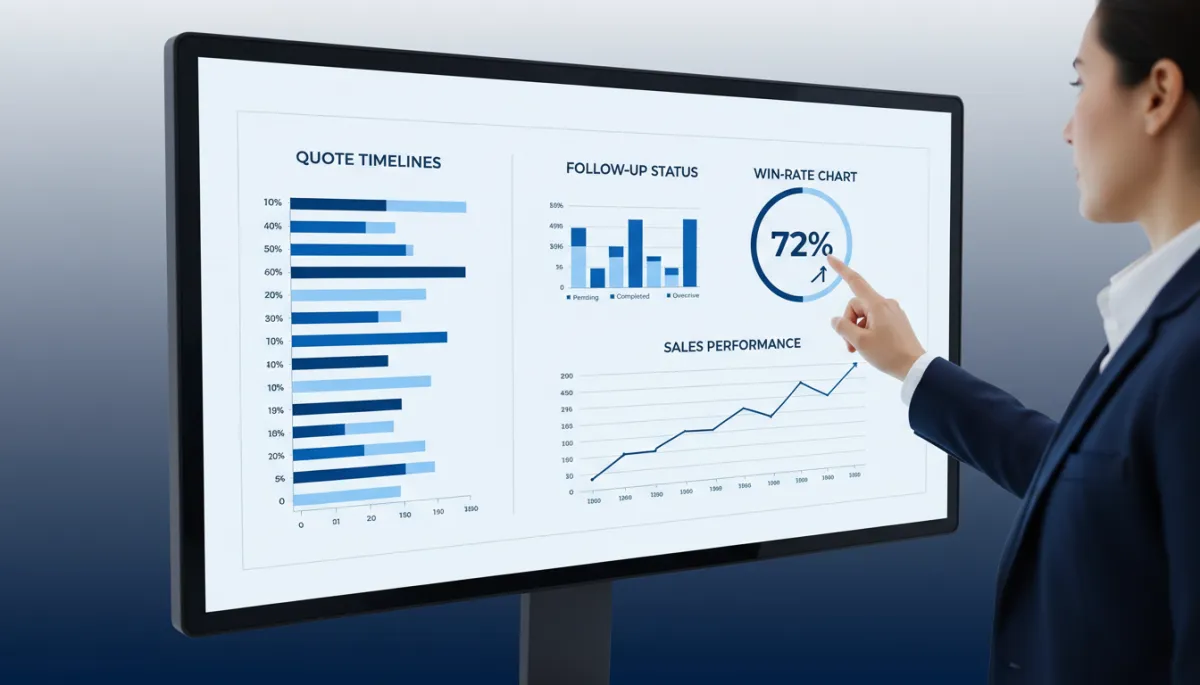
Automated follow-up turns quotes into live conversations instead of static documents waiting in inboxes.
Why Complete Still Beats Fast Alone
Speed without completeness is just a faster way to lose. A vague “we’ll be between $5,000 and $9,000” may technically arrive first, but it will not become the buyer’s anchor. The benchmark quote is the one that gives the decision-maker enough detail to defend their choice internally: clear scope, line items, assumptions, and terms that feel professional and trustworthy.
That is why Bot-Brand focuses on complete-fast, not fast-sloppy. AI can compress the repetitive steps so your team can spend their judgment bandwidth on making the estimate precise, aligned with expectations, and easy to say yes to. When you are both first and complete, competitors are forced to explain why their quote is missing elements you have already framed as standard.
💡 Pro Tip: Review your last 20 lost deals and ask: “Did we lose on price, or did we lose on being the first complete, defensible estimate?”
The Request-to-Send Interval: The Metric That Predicts Win Rate
Most teams track how many quotes they send and what percentage close. Far fewer measure the request-to-send interval: the time between a qualified request for pricing and the moment a complete quote lands in the prospect’s inbox. In Bot-Brand’s diagnostics, this single metric consistently predicts win rate more reliably than minor pricing differences or cosmetic proposal changes.
When that interval stretches past 24–48 hours, the probability that a competitor has already anchored the buyer increases dramatically. Even if your pricing strategy is stronger and your estimate accuracy is higher, you are negotiating against an invisible first quote you never saw. Conversely, when your request-to-send interval is measured in hours instead of days, and your quotes are complete, you set the baseline everyone else has to fight uphill against.

Tracking request-to-send time exposes hidden bottlenecks and directly correlates with quote win rates.
Engineering a High-Velocity, High-Integrity Quoting System
For high-volume local service businesses and enterprise agencies, quoting is no longer a side task; it is a core system. To compete, you need autonomous infrastructure that can intercept leads, structure intake, assemble quotes, and trigger automated follow-up without constant human intervention. That is exactly what Bot-Brand’s AI architecture is designed to do: remove manual bottlenecks while preserving precision logic and margin control.
Neural lead-capture engines that gather quote-critical details with human-grade conversation and clarity
AI-driven mapping from intake answers to your priced unit library and templates
Automated follow-up sequences across email, SMS, voice, and chat that keep quotes active without extra labor

Autonomous quote infrastructure aligns speed, accuracy, and follow-up around one unified sales process.
Next Step: Turn Quotes into an Autonomous Advantage
If your team hears “you were just a bit higher” more often than you win, it is time to question whether you are truly losing on price—or whether you are losing on speed to complete estimate. By compressing quoting delay, anchoring first with complete proposals, and automating follow-up, you turn a chronic bottleneck into a structural advantage in your sales process.
Bot-Brand specializes in building this kind of 24/7 autonomous operational infrastructure. If you want to see exactly where your quoting delay lives, how your request-to-send interval compares, and what an AI-powered quote management system could recover in revenue, there is a clear next move: Initialize a Secure Uplink for an Architectural Audit and Systems Diagnostic. From there, we can map a quoting environment where complete, fast, and automated becomes your new normal—and “lost on price” stops being the easy excuse.