Fix Duplicate Customer Data Issues Easily
Customer Data, Automation, Operations
The Hidden Cost of Duplicate Customer Data (and the Four-Step Fix)
Every ambitious business eventually discovers the same quiet problem: the bigger you grow, the more your customer data drifts, duplicates, and fractures across platforms. At Bot-Brand, we see it in almost every high-volume local service business and enterprise we audit—long before they try to deploy serious automation or AI agents.
How Growing Businesses Accidentally Create Duplicate Customer Records
Duplicate customer data rarely comes from reckless decisions. It comes from reasonable choices made under pressure—the same pressure that drives growth. As volume increases, teams reach for whatever tools help them move faster in the moment:
A new booking app is added “just for the field team.”
Marketing spins up a landing page platform with its own contact database.
Sales starts logging notes in a shared spreadsheet “until the new CRM is ready.”
None of these decisions are wrong in isolation. They are survival moves. But each new intake form, chat widget, or call-tracking tool quietly creates its own version of your customers. Over time, ordinary operational drift sets in:
The same person appears as “Sarah J.” in the CRM, “Sarah Jones” in the booking tool, and “S. Jones” in a spreadsheet.
One email lives in your newsletter platform, another in your invoicing system, and a third in your help desk.
Multiply this by thousands of leads and customers, and you no longer have a single customer base—you have parallel realities scattered across platforms. By the time a business calls Bot-Brand to deploy AI agents and neural lead-capture flows, these realities are colliding in ways that quietly bleed revenue and trust.

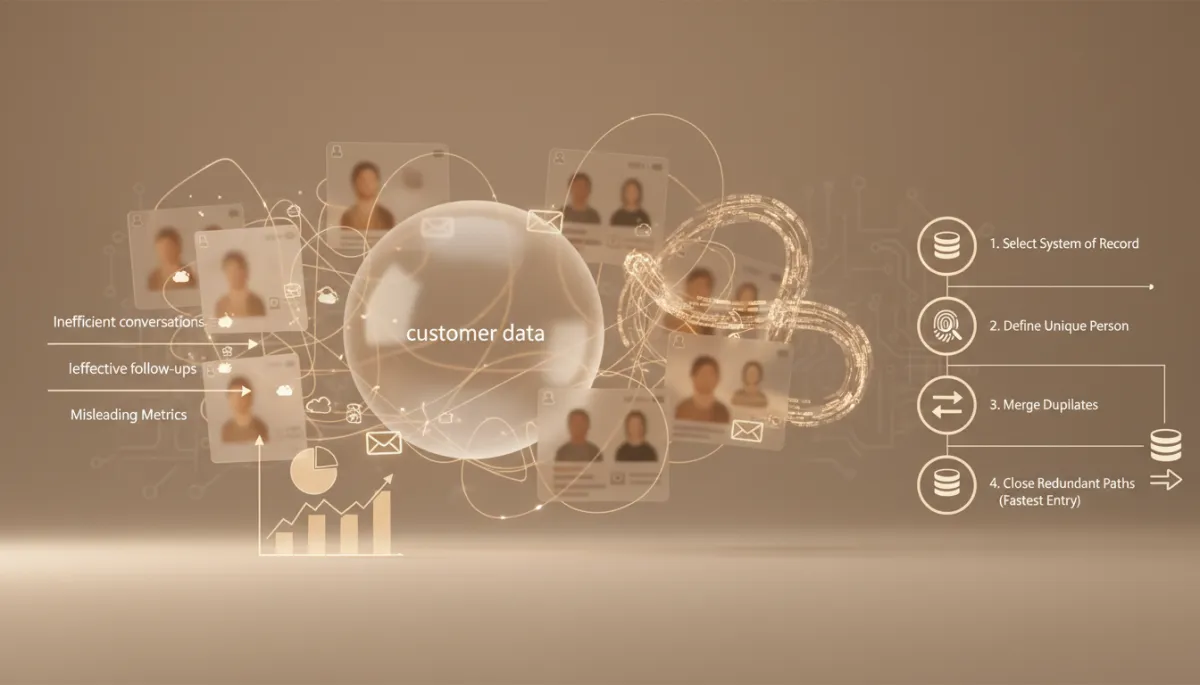
Parallel customer records create quiet operational drag long before anyone notices the pattern.
The Real Cost of Duplicate Data: Conversations, Follow-Ups, and Metrics
Duplicate records are not just a “data hygiene” issue. They reshape the day-to-day reality of how your team talks to customers, how your systems follow up, and how you make decisions at the leadership level.
1. Inefficient, Repetitive, and Awkward Conversations
When your team is operating from different versions of the same customer, conversations become clumsy:
A dispatcher asks for details the customer already gave online.
A sales rep calls about a quote that was already accepted in another system.
Support has no context on a recent visit because that record lives in a different platform.
Customers experience this as friction and forgetfulness. Internally, it feels like your team is always “catching up” instead of operating with precise, shared context. That is the opposite of precision logic and digital autonomy—two values Bot-Brand is hired to restore.
2. Ineffective or Conflicting Follow-Ups
Duplicate records mean your systems do not agree on where a customer is in the journey. As a result:
One system thinks the lead is “new” and sends an introductory offer.
Another thinks they are “in progress” and triggers appointment reminders.
A third marks them as “customer” and sends loyalty messaging.
From the customer’s perspective, this looks chaotic and robotic—not intelligent. From your team’s perspective, it creates manual firefighting: pausing campaigns, apologizing, and trying to reconcile who is actually where in the funnel.
3. Misleading Metrics and Bad Decisions
Leaders rely on metrics to decide where to invest. Duplicate data quietly corrupts those metrics:
Lead volume appears higher than it is because the same person is counted three times across tools.
Conversion rates look lower because “leads” that are actually existing customers never “convert.”
Campaign performance is misread because revenue and engagement are tied to partial or fragmented records.
When Bot-Brand runs an Architectural Audit, we often find that a “lead-generation problem” is actually a data integrity problem. You are not underperforming—you are mis-measuring. That mis-measurement leads to the wrong bets, the wrong channels, and the wrong priorities.

Inflated lead counts and skewed conversion rates often trace back to duplicate records.
Why Automation Can Make Bad Data Much Worse
Automation does not fix bad data; it amplifies whatever reality you feed it. When you connect AI voice agents, chatbots, and automated follow-up sequences to a fractured data layer, you are effectively telling them: “These conflicting versions of the truth are all correct.”
The result can be:
Multiple automated sequences contacting the same person as if they were different leads.
AI agents responding based on outdated or incomplete context from a secondary system instead of the latest record.
“Smart” routing that sends calls or chats to the wrong team because the automation trusts a stale status field.
For a brand promising 24/7 autonomous operational infrastructure, this is unacceptable. Bot-Brand’s Neural Intercept Protocol is built on the assumption that there is a single, authoritative view of each person. If that assumption is false, your AI will still move fast—but in the wrong direction, at scale.
📌 Key Takeaway: Before you scale automation, you must stabilize reality. Clean, unified customer data is a prerequisite for trustworthy AI behavior.
The Four-Step Fix: From Fragmented Data to a Single Source of Truth
The good news: you do not need a five-year transformation program to regain control. You need a focused, disciplined sequence. At Bot-Brand, we guide clients through a four-step framework that restores technical architectural integrity and prepares their systems for autonomous operation.
Step 1: Select One System of Record
First, you must decide: Which platform is the ultimate authority on customer identity and status? This becomes your system of record. Everything else becomes a satellite.
For many service businesses, this is the CRM or core booking platform.
For some enterprises, it may be a customer data platform (CDP) or custom database.
The key is clarity: if there is ever a conflict, this system wins. All AI agents and automations should ultimately defer to it for identity and lifecycle status.
Step 2: Define What Makes a Person Unique
Next, you must specify the rule set that determines when two records are actually the same person. This is your identity logic.
For example, you might decide that a unique customer is defined by:
Email address (primary), plus
Phone number (secondary), and
Name and zip code as tie-breakers when one of the above is missing.
The exact formula will vary by industry, but it must be explicit and consistently applied. This logic is what allows Bot-Brand’s Neural Intercept flows to recognize “this is the same human,” even when they arrive through different channels.

Clear identity rules let systems recognize one human across many touchpoints.
Step 3: Merge Duplicates into a Single Golden Record
With your system of record and identity rules in place, you can begin consolidating. The goal is to create a golden record for each person—a single profile that contains the best, most complete version of their data.
Practically, this means:
Identifying likely duplicates using your uniqueness rules.
Merging records so that history, notes, and transactions roll up into a single profile.
Archiving or flagging the old IDs so they are not reactivated or resynced.
This can be done in phases, starting with your highest-value segments: active customers, high-intent leads, and key accounts. Each merge reduces noise and increases the reliability of every automated decision downstream.
Step 4: Close Redundant Intake Paths and Make the Right Path Fastest
Finally, you must stop the problem from recreating itself. That means closing or rerouting redundant intake paths and ensuring that the correct entry path is also the fastest and most convenient for both customers and staff.
Concretely:
Replace rogue forms and spreadsheets with standardized, integrated capture flows into your system of record.
Ensure all AI chat, voice, and landing page experiences write directly—and only—to that system of record.
Make the official path easier than the workarounds, so teams naturally default to it.
This is where Bot-Brand’s high-end landing page infrastructure and Neural Intercept Protocol shine: every inbound call, chat, and form flows through a single, architected intake layer that respects your identity rules and keeps your data clean as volume scales.

The fastest, official intake path must feed your single source of truth every time.
From Chaos to Autonomous Clarity
Duplicate customer records are not a sign of failure—they are a predictable side effect of growth. But if you ignore them, they quietly tax every conversation, every follow-up, and every strategic decision you make. And when you layer automation on top of that chaos, the problems accelerate.
By selecting a single system of record, defining what makes a person unique, merging duplicates into golden records, and closing redundant intake paths, you create the conditions for true digital autonomy. Your AI agents can finally operate with confidence, your metrics align with reality, and your teams stop fighting their tools and start leveraging them.
💡 Pro Tip: Treat data integrity as infrastructure, not an afterthought. The businesses that win with AI are the ones that respect the foundation before scaling the automation.
If you are ready to move from fragmented records to a unified, autonomous sales and service layer, Bot-Brand can help you architect the entire stack —from data model to Neural Intercept flows to 24/7 AI agents. The first step is understanding the current state of your systems and where duplicate realities are hiding.
Initialize a Secure Uplink for an Architectural Audit and Systems Diagnostic, and we will map your customer data landscape, expose the duplication drag, and design a path to clean, synchronized, and automation-ready infrastructure—so every conversation, human or AI, starts from the same precise truth.