Hidden Costs of Broken Intake in Service Jobs
Operations, Intake Failures, Service Delays, Information Accuracy
When Jobs Go Sideways: The Hidden Cost of Broken Intake in Service Businesses
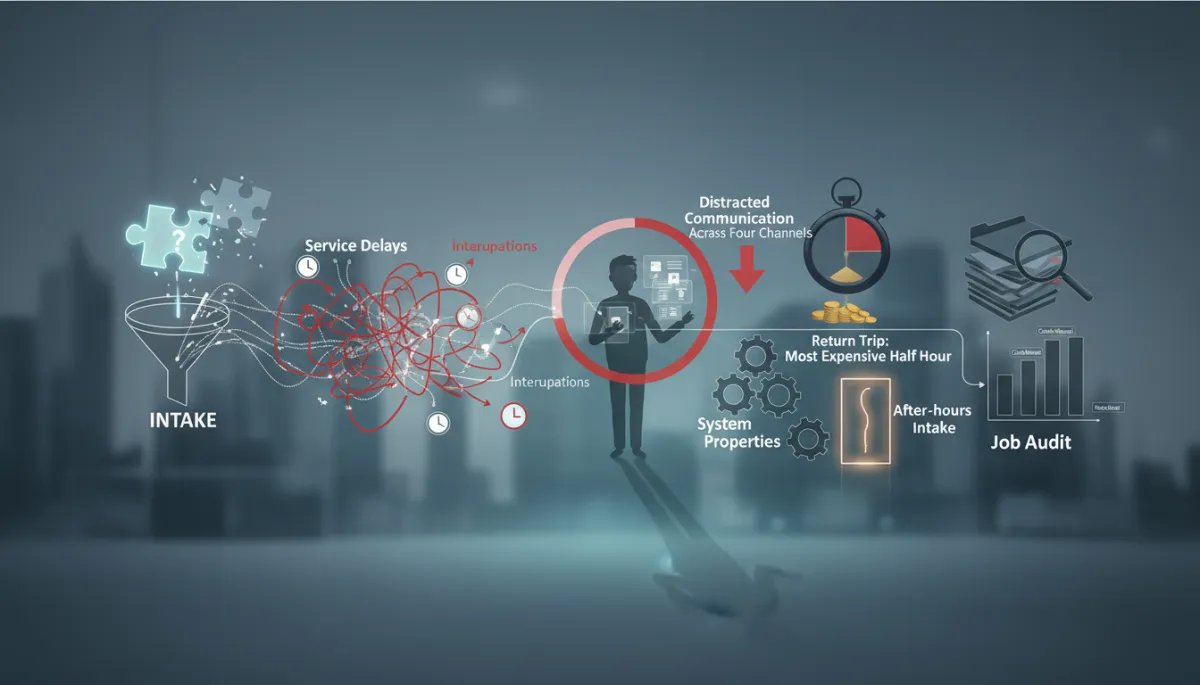
Most field jobs do not fail on the driveway or the job site. They fail in the first three minutes—at intake—when a single missing detail quietly sets off a chain reaction of interruptions, delays, and expensive return trips. For high-volume local service businesses, this is not a nuisance; it is a structural drag on margin and growth. Bot-Brand works with operators who are tired of guessing where the waste is hiding and want an intake system that performs with the precision of infrastructure, not the fragility of memory.
Intake Failures: Where “Good Jobs” Quietly Go Bad
Ask any service manager about their worst weeks and you will hear the same pattern: technicians driving back across town, schedules unraveling by noon, and frustrated customers asking why “no one told me you needed that information earlier.” On paper, these look like field execution problems. In reality, most of these jobs failed at intake, the moment information was captured—often incomplete, inconsistent, or never written down at all.
Across industries, from home services to healthcare to government agencies, intake failures are a primary driver of Service Delays. The IRS’s 2026 filing season is a high-profile example: more than 14 million returns were suspended during processing and over one million taxpayers waited about 5½ weeks beyond normal timelines for refunds, largely due to missing or mismatched data in initial submissions and follow-up intake channels (IRS, 2026 Mid-Year Report). When intake breaks at scale, operations slow to a crawl.
The True Multiplier of a Single Missing Detail
Consider one missing detail: gate code, panel model number, pet on premises, access window, or “who approves the invoice.” On its own, it looks trivial. In practice, it multiplies cost in three predictable stages:
Interruption: The technician arrives and cannot proceed. They call the office. The dispatcher stops what they are doing to find the customer. Two people are now idle while the clock runs. This is the first visible Service Delay triggered by an intake gap.
Delay cascade: While the technician waits, the next appointment is pushed back. Afternoon jobs compress. Customers get “your technician is running behind” calls. One missing detail now distorts the entire day’s schedule and erodes perceived reliability.
The return trip: If the issue cannot be resolved on the spot—wrong part on the truck, missing authorization, no access—the technician leaves and returns another day. This is the most expensive half hour in any service business: drive time with no new revenue, just paying to correct an avoidable Intake Failure.
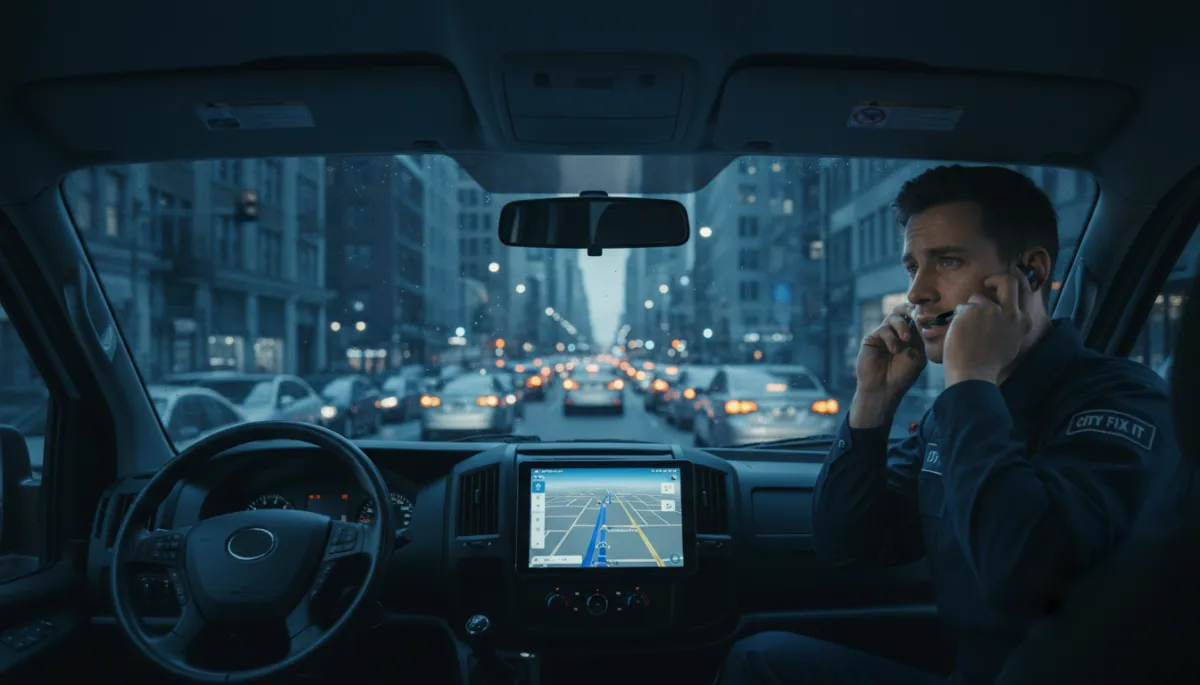
Each unnecessary return trip compounds fuel, labor, and opportunity costs across your fleet.
Multiply this by dozens of jobs per week and the math gets unforgiving. A single missing detail can quietly consume hundreds of technician hours per quarter, not to mention the brand damage of repeated apologies and rescheduling. From Bot-Brand’s perspective, this is not a “people problem” but a systems architecture problem: your intake layer is not engineered to capture the full information set with repeatable accuracy.
Why “Ask Better Questions” Fails as a Fix
Many businesses respond to recurring Intake Failures with a familiar directive: “We just need to ask better questions.” In theory, this sounds reasonable. In practice, it fails for one simple reason: intake does not happen in a quiet conference room with a checklist and unlimited time. It happens while distracted, across four channels, under pressure:
The phone is ringing and another call is already on hold.
A web form just dropped a new lead into the inbox that “needs a fast response.”
A customer is texting photos while the dispatcher is answering email.
A technician is standing at the desk asking about parts for a different job.
Human memory and attention are not designed to run four concurrent intake streams with perfect Information Accuracy. Telling staff to “remember to ask” is like telling drivers to “just be more careful” instead of installing lane-keeping systems. Without a mechanical, enforced intake structure, Effective Questioning will always collapse under real-world load and context-switching.
📌 Key Takeaway: If your intake success depends on an individual’s memory or mood, it is not a system. It is a gamble.
The Four Mechanical Properties of a Real Intake System
Bot-Brand designs intake as infrastructure: a repeatable, autonomous layer that intercepts and qualifies every lead with the same rigor, 24/7. In our work with high-volume operators, four mechanical properties consistently separate robust intake systems from fragile ones:
Non-optional completeness: The system will not advance the job until required fields are captured. Whether intake happens via AI voice, chat, or form, essential data (address, access constraints, equipment type, decision-maker, urgency, budget guardrails) must be structurally mandatory, not “nice to have if we remember.”
Channel-agnostic logic: The same decision tree and Effective Questioning logic must run across phone, web, SMS, and chat. A customer who calls at 9:00 a.m. and a customer who messages at 11:30 p.m. should pass through the same Neural Intercept protocol, not four different, inconsistent experiences.
Real-time validation and clarification: A true intake system does not just record answers; it checks them. If a customer says “sometime next week,” the system converts that into a precise time window. If a model number is missing, it prompts for a photo. This is where AI-driven agents excel—clarifying ambiguity at the edge instead of pushing confusion downstream.
Instant synchronization with operations: Once captured, data must flow directly into your CRM, dispatch, and billing stack with no retyping. Every time a human copies information from one system to another, you create another opportunity for Intake Failures and Service Delays. Bot-Brand’s 24/7 autonomous infrastructure is built specifically to eliminate this manual relay.
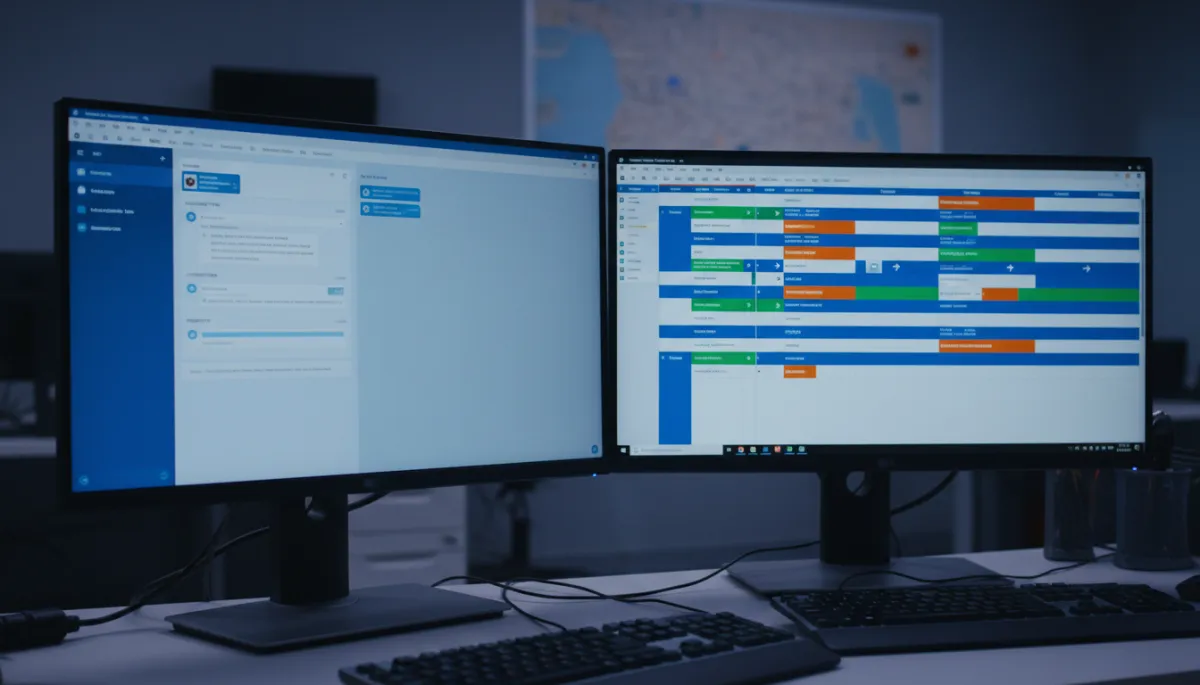
Structured, synchronized intake data removes guesswork for dispatchers and field teams.
Why After-hours Intake Is the Thinnest and Warmest
After-hours Intake is where most service businesses are exposed. During the day, at least someone is watching the phones and inbox. After 5:00 p.m., coverage gets thin—yet lead intent is often at its warmest. A homeowner with a broken system at 9:30 p.m. is not “just browsing.” They are ready to book, and they are choosing between you and the next result on Google.
Many firms rely on voicemail, basic web forms, or outsourced answering services after hours. These channels are notoriously light on Information Accuracy: missing photos, vague problem descriptions, no access constraints, no clear urgency tagging. The result is a next-morning scramble—callbacks, clarification questions, and lost momentum. Research on after-hours support shows that businesses offering structured, technology-driven after-hours intake see higher customer satisfaction and better workload distribution across the day (Forbes Tech Council, 2023).
Bot-Brand’s Neural Intercept protocol was built specifically for this edge case: intercepting after-hours leads with human-grade conversation, extracting the full intake dataset, qualifying urgency, and synchronizing everything into your systems before your team arrives in the morning. Instead of waking up to vague voicemails, your schedulers open a board filled with fully qualified, ready-to-route jobs.

24/7 autonomous intake converts late-night emergencies into fully qualified, next-day jobs.
A Concrete Job Audit: Quantifying the Cost of Intake Failures
Before you invest in new tools or training, you need proof of where the friction lives. Here is a simple Job Audit Bot-Brand recommends to every operator we work with. It requires no software, only discipline and honesty:
Pull the last twenty jobs. Choose a representative mix: different technicians, different service types, a blend of daytime and After-hours Intake sources if possible.
Identify every callback before dispatch. For each job, ask: did we have to call, text, or email the customer again before the truck rolled, just to clarify information that should have been captured at first contact?
Flag jobs that required a return visit. Was the return visit caused by missing or inaccurate intake data (wrong part, no access, wrong contact, unclear scope)?
Classify the root cause. For each flagged job, label the failure: missing detail, ambiguous detail, or unsynchronized detail (captured but not visible to the field).
Quantify the cost. Estimate technician time lost, dispatcher time spent, fuel, and any discounts or concessions given to the customer. Even conservative estimates will reveal a meaningful drag on margin.
In most high-volume environments, this simple Job Audit reveals that 30–50% of recent jobs required at least one avoidable callback for information that was available—or could have been available—at first contact. That is not a training gap; it is evidence that your intake architecture is leaking value on nearly every shift.
From Chaotic Intake to Autonomous Infrastructure
Intake does not need to be the weakest link in your operation. When you treat it as core infrastructure—engineered, enforced, and autonomous—you convert a chronic liability into a competitive advantage. Jobs stop “going sideways” because the information arriving at dispatch and the field is complete, validated, and synchronized by design, not by hope.
Bot-Brand’s Neural Intercept Protocol is built around the principles outlined above: non-optional completeness, channel-agnostic logic, real-time clarification, and instant synchronization. Deployed as 24/7 AI voice and chat agents, it replaces fragile manual intake with precise, autonomous capture and routing. The result is fewer Service Delays, higher Information Accuracy, and a dramatic reduction in the costly return trips that quietly erode your margins.
💡 Pro Tip: Run the twenty-job audit this week. If more than five jobs required avoidable callbacks, you are operating with a structural intake risk that AI infrastructure can measurably reduce.
If you are ready to replace manual intake bottlenecks with a precise, autonomous system that intercepts, qualifies, and synchronizes every lead—day and night—Bot-Brand can help. Initialize a Secure Uplink for an Architectural Audit and Systems Diagnostic, and we will map exactly where your intake is leaking value and how a Neural Intercept layer can restore precision, protect margin, and scale your operation without adding headcount.