Unveiling Hidden Processes in Business Operations
Operations, Process Design, Automation
When “Five Simple Steps” Hide a Second, Invisible Process
On paper, your business runs in a clean line. In reality, every job bends around real customers, real constraints, and real judgment. The gap between those two worlds is where automation stalls, onboarding drags, and your numbers quietly stop telling the truth. This is exactly the gap Bot-Brand is built to close.
The Story Every Owner Tells: “It’s a Simple Five-Step Process”
Ask most owners how their operation works and you’ll hear a confident, thirty‑second answer. It usually sounds like this: “Lead comes in, we qualify, schedule, do the work, and invoice. Five steps.” Clean. Linear. Easy to draw on a whiteboard, easy to explain to a vendor, and easy to believe you can automate with one good software stack.
Then you look at the last ten actual jobs. Not the ideal jobs. Not the training examples. The last ten real jobs that came through the door. And you see something very different: each one took a different path. One skipped a step, one added three, one involved a last‑minute reschedule, one went to a senior tech instead of the normal crew, one was split across two days because the customer’s kids were home. Same business, same owner, same “five steps” — ten different realities.
How Good Judgment Quietly Builds a Second, Undocumented Process
None of those deviations are mistakes. They’re competent people making correct calls for specific customers. Over time, that good judgment accumulates. Your team learns:
This commercial client always needs a pre‑site call.
That neighborhood has parking issues, so we schedule longer windows.
Warranty jobs go straight to a senior tech with different notes.
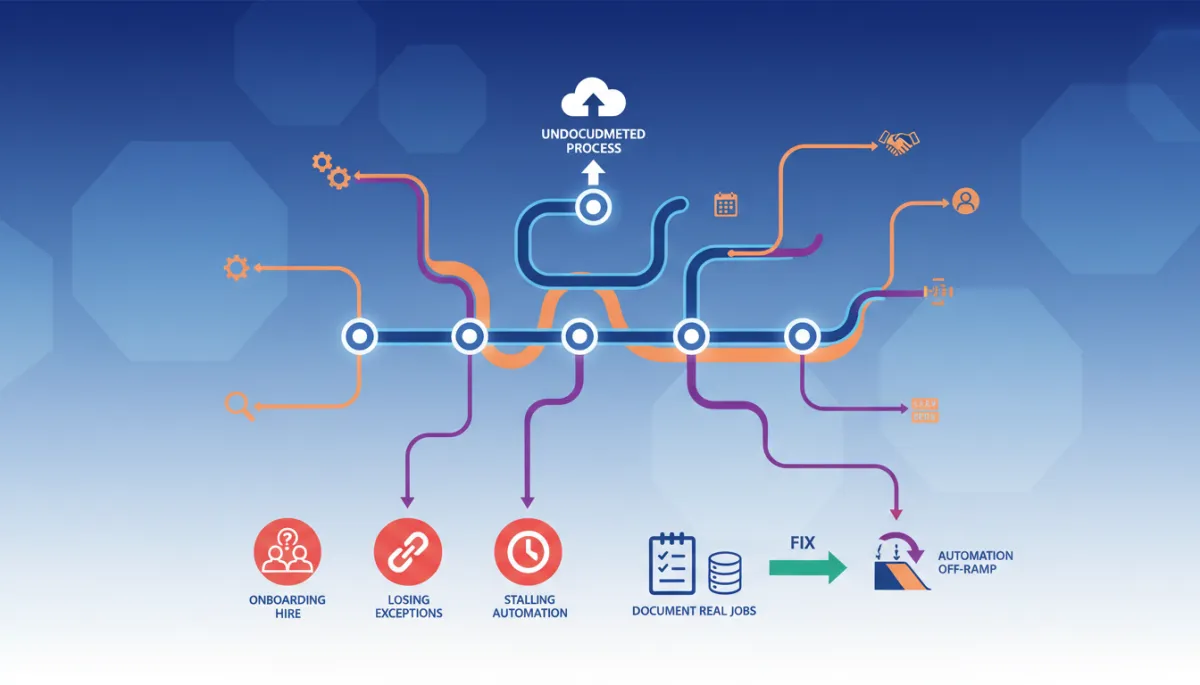
These are smart moves. But they’re usually stored in conversation, not in your system. The result is an undocumented second process nobody officially chose. It lives in text threads, hallway chats, and “quick favors.” It’s the process that actually runs your high‑volume local service business, while the five‑step diagram sits in a slide deck or SOP binder.
📌 Key Takeaway: You don’t have one process. You have the official process you describe — and the real process your team actually runs for customers every day.
The Four Moments Your Invisible Process Starts Costing You
At first, this shadow process feels like agility. People are flexible, customers are happy, fires get put out. But as you scale volume, locations, or headcount, the hidden process starts to hurt in four predictable moments.
1. Onboarding a Hire Into an Oral Tradition
When you onboard a new coordinator, dispatcher, or sales rep, you don’t just hand them a playbook. You also quietly initiate them into an oral tradition. They shadow “Sarah,” who explains, “We usually do it like this, but for these guys we do it differently. You’ll get the hang of it.” The five‑step process gets taught in an hour. The real, exception‑driven process takes weeks of observation, mistakes, and apologies to customers.
2. Losing the Exceptions When Someone Leaves
The day a key person walks out, they don’t just take capacity — they take exceptions. All those unwritten rules about which client gets what treatment, which vendor always needs a reminder, which jobs must be double checked — gone. The second, undocumented process leaves with them. Your remaining team has to rediscover those patterns, often the hard way, with missed details and damaged trust.
3. Stalling Every Automation Project on “Well, Except When…”
This is where Bot-Brand usually meets you. You’re ready to automate: AI answering calls, qualifying leads, booking jobs, syncing everything into your CRM. The logic looks straightforward — until your team starts adding caveats.
“Well, except when it’s a warranty call.”
“Except when it’s that big property manager; we route those differently.”
“Except when it’s an emergency and the tech is already nearby.”
Every “well, except when” is a fragment of that invisible second process. Your automation project slows or stalls, not because AI can’t handle complexity, but because nobody has named the complexity yet. The logic exists only in people’s heads, not in your architecture.
4. Having Numbers You Can’t Trust Because Work Entered Six Different Ways
Finally, the invisible process shows up in your data. Jobs are booked by phone, text, web form, chat, and “I know the owner, just squeeze me in.” Different people enter the same type of work in different ways. Some skip fields that “don’t really matter.” Some use notes instead of structured fields. Some duplicate jobs and cancel one later. The result: you have numbers you can’t trust because the same work is entered six different ways.

When the same job type is recorded six ways, your metrics quietly lose integrity.
The Fix: Start With the Last Twenty Jobs, Not the Whiteboard
There’s a simple, disciplined way to surface the hidden process without guesswork or endless meetings. Before you document anything, before you design an AI workflow, before you buy another tool, do this: pull the last twenty real jobs and write down what actually happened.
Export or print the last twenty completed jobs of a single core type. Don’t cherry‑pick. Take them in order.
For each job, write down the real steps in sequence — channel, handoffs, delays, approvals, reschedules, exceptions. No idealization, just facts.
Then, count the deviations. Where did the job depart from your clean five‑step story? Was there an extra confirmation call? A manual quote rework? A tech swap? A special note to accounting? Mark every deviation across those twenty jobs.
💡 Pro Tip: Don’t ask anyone to describe the process first. Description pulls you back to the ideal. Reality lives in the job history.
Promote Repeating Deviations Into Named Paths
Once you’ve counted the deviations, patterns will appear. A handful that repeat across those twenty jobs are your unwritten rules. They are not noise — they are real paths your operation runs regularly. Those should be promoted into named paths.
“Standard Residential Job”
“Warranty Revisit”
“High‑Value Commercial Client”
Each named path gets its own clear steps, fields, and rules. When Bot-Brand designs a Neural Intercept protocol for your top‑of‑funnel, we wire these named paths directly into the AI’s decision tree. The AI doesn’t just know “book a job”; it knows which job path it’s booking and what exceptions are baked into that path by design.
Let the True One‑Offs Stay Human Judgment Calls
Not every deviation deserves a new process. Some are truly rare: the client whose building flooded during a storm, the job that required three different vendors, the VIP favor for a long‑time friend. Those true one‑offs should stay judgment calls, handled by a senior person with context and authority.
The goal of strong automation isn’t to erase human judgment. It’s to reserve judgment for where it adds the most value, while the AI and systems execute the 80–90% of work that follows clearly defined, named paths with precision and consistency.
Every Automated Process Needs a Deliberate Off‑Ramp
There’s one more critical design rule: every automated process needs a deliberate off‑ramp. If your AI or software workflow has no clear way to say, “This one is special; hand it to a human,” your team will create their own back doors. They’ll text each other, bypass the system, or “just handle it” offline.
A system with no exit is one people route around until the record is incomplete and nobody trusts it. Jobs get done, but the system shows half the story. Leadership stops believing the dashboard. Techs stop relying on the notes. Your automation becomes a suggestion, not an authority.
At Bot-Brand, every Neural Intercept workflow and autonomous agent we deploy includes explicit off‑ramps: clear conditions where the AI routes a case to a human with full context, marks it as an exception, and keeps the data trail intact. That’s how you maintain both precision logic and trustworthy records as volume scales.
Turning Invisible Judgment Into Scalable, Autonomous Infrastructure
The businesses that scale cleanly don’t have fewer exceptions. They have a clearer map of which exceptions are actually patterns and which are truly rare. They treat their team’s judgment as a data source, not a mystery. They promote repeating deviations into named paths, keep one‑offs human, and design every automated flow with a safe, visible off‑ramp.
That’s the foundation of absolute digital autonomy: autonomous AI voice and chat agents, neural lead‑capture engines, and landing page infrastructure that don’t just mimic your five‑step diagram, but actually reflect how your operation works in the field — with integrity, consistency, and human‑grade inflection where it matters.
Next Step: Initialize a Secure Uplink for an Architectural Audit and Systems Diagnostic. Bot-Brand will help you surface the second process your team is already running, promote the right exceptions into named paths, and engineer autonomous infrastructure that your people — and your numbers — can trust.