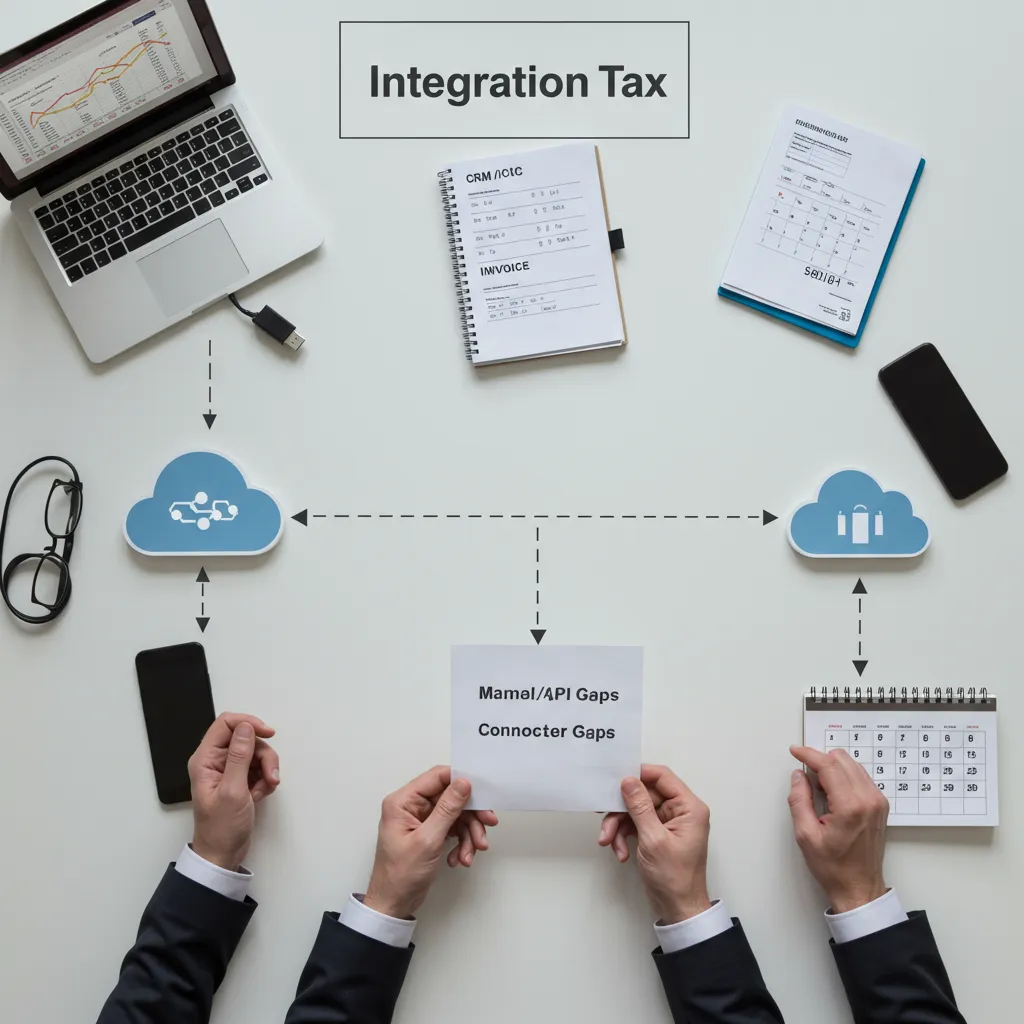
The Integration Tax: How 7 Disconnected Tools Cost You 11 Hours a Week
Published May 18, 2026 · Bot-Brand · 6-minute read
The average service operation runs seven different software tools. CRM. Scheduler. Invoicing. Email platform. SMS app. Review system. Accounting. Each tool works fine on its own. None of them talk to each other.
That gap — the unautomated space between two systems that should hand off cleanly — is the Integration Tax. And it's quietly eating eleven hours a week off your operation.
What the Integration Tax Actually Is
It is not a software fee. It is the manual labor required every time a piece of information has to cross the boundary between two disconnected systems.
A lead comes in through your contact form. Someone copies it into the CRM. Someone else schedules the appointment in a separate calendar app. After the job, an invoice gets created in a third tool. The receipt gets emailed manually. The review request gets sent — or forgotten — through a fourth platform.
Every one of those handoffs is unbilled overhead. You are paying a human to do what a properly architected system handles in milliseconds.
The Five Manual Handoffs Every Service Business Runs
Run your operation against this list. Count the ones you are doing by hand.
Lead capture to CRM.Web form, paid ad, referral text — somebody is copy-pasting that data into the CRM.
CRM to scheduler.A booking gets created in a calendar that does not know about the contact record.
Job complete to invoice.Crew finishes, somebody opens accounting software, manually creates the invoice.
Invoice paid to review request.Payment clears. Nothing automatically asks for the review.
Lead gone cold to nurture sequence.Prospects sit in the CRM for months with zero follow-up because no logic branches are triggering.
Five handoffs. Two minutes each. Ten times a day. Five days a week. That is the eleven hours.
Calculating Your Real Number
Multiply the handoffs you are doing manually by 2 minutes. Multiply by your daily lead and job volume. Multiply by 22 working days.
A roofing operation doing 8 leads a day across 5 manual handoffs is burning 14.6 hours a month on data movement alone. At a $25 per hour blended labor cost, that is $365 a month — before counting the leads that go cold, the invoices that go out late, and the reviews that never get requested.
Now factor in lost revenue. Every 5-minute delay on a fresh lead drops conversion probability by roughly 80 percent. The integration gap is not just labor cost. It is a hole in your top-line revenue.
Why Adding Zapier Is Not the Answer
Most operators reach this realization and bolt on a Zapier account. Two Zaps later, the manual work moves around but the architecture does not change. You have added a fragile dependency on top of seven brittle systems.
The reason Zapier does not solve the problem: it patches symptoms at the API level without restructuring the data flow underneath. The handoff still exists. It is just hidden inside a Zap that breaks the next time a field name changes.
Real infrastructure means consolidating the data layer. One source of truth for contact records. One trigger logic that fires across the full customer lifecycle. One reporting surface that shows you what is happening without logging into four dashboards.
Infrastructure vs. Automation: The Distinction That Matters
Automation is a single task running without you. Infrastructure is the entire operating environment that makes hundreds of tasks coordinate.
A Zap that copies a lead into your CRM is automation. A unified system where every lead is scored, routed by logic branches to the right pipeline, assigned an SMS sequence based on source, and surfaced in your dashboard with a behavioral history — that is infrastructure.
Bot-Brand engineers infrastructure. Neural Lead Engines, integrated CRM logic, multi-stage outbound and nurture protocols. The goal is not to save you a Zap. It is to eliminate the boundary between systems entirely.
What Eliminating the Tax Looks Like
When the Integration Tax goes to zero:
Every inbound lead is in the CRM and assigned a follow-up sequence within 60 seconds.
Scheduling, invoicing, and review requests fire automatically off pipeline stage changes.
Cold leads enter logic-branched nurture without anyone remembering to add them.
Your team focuses on the work that requires a human — not data entry.
That eleven hours a week comes back. So does the revenue from leads that no longer go cold in the gap between systems.
Run the Audit
The first step is knowing your number. Count the manual handoffs. Multiply. Look at what it is costing you.
If the math is bad enough to act on, we architect the system that closes the gap. Single platform. Integrated logic. Zero handoff overhead.