Optimize Onboarding: Beyond Shadowing Training
Onboarding Process, Shadowing Training, Process Knowledge Management
When Shadowing Becomes Your Onboarding Process: Hidden Costs and a Better Way
For many growing businesses and agencies, the default Onboarding Process is simple: “sit with Sarah, watch what she does, and copy it.” Shadowing Training feels practical and human, but it quietly shapes how your organization thinks, executes, and scales. When you rely on shadowing as the primary training method, you are not just transferring skills—you are cloning systems, quirks, and blind spots in one move.
The Three Things Shadowing Transfers—Whether You Like It or Not
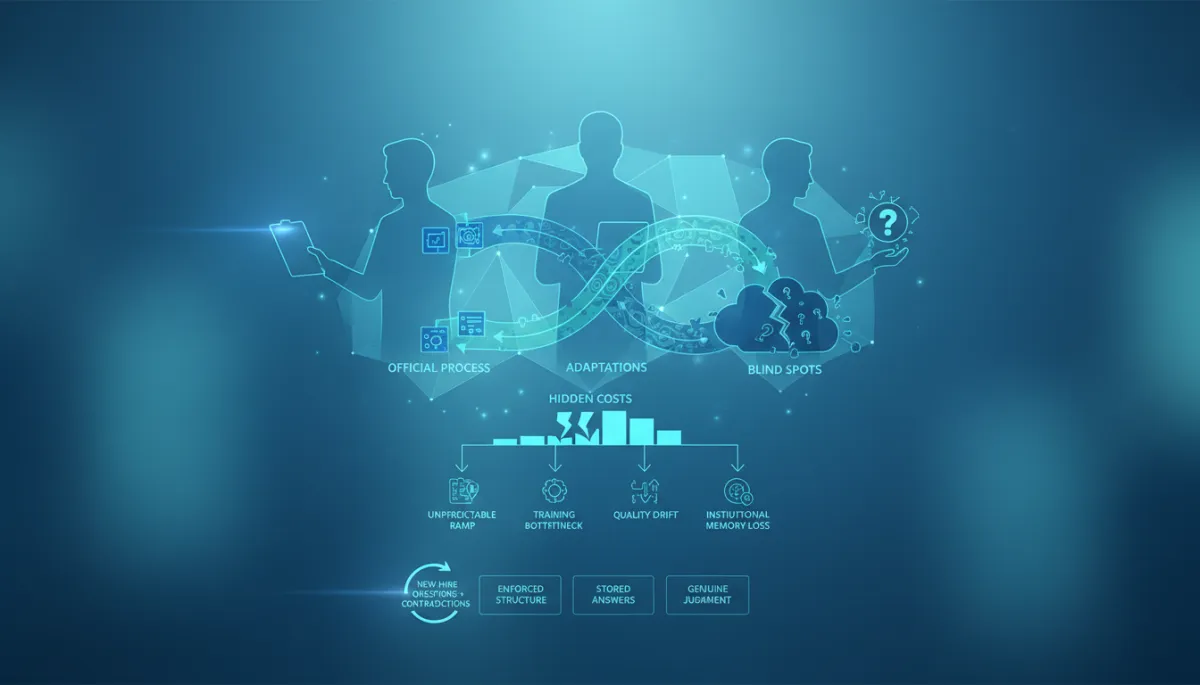
Shadowing feels low-friction: pair a new hire with a strong performer and let them absorb the role. But in reality, three distinct layers transfer at once—and they all arrive with equal authority in the new hire’s mind:
The official process: whatever the organization believes is “how we do things here,” even if it only exists in a slide deck or someone’s memory.
The trainer’s personal adaptations: shortcuts, workarounds, personal preferences, and optimizations they have developed over time to hit their numbers or save time.
The trainer’s blind spots: missing steps they no longer notice, outdated assumptions, and areas they think are “obvious” but are not.
The problem is not that personal adaptations are bad; some of them are brilliant. The problem is that the new hire cannot distinguish between official process, personal style, and accidental omission. All three are absorbed as “the way it is done,” and all three become part of your operational DNA—without review, design, or governance. For businesses pursuing precision, autonomy, and scale, that is a structural risk, not a training detail.
The Hidden Costs of Shadowing-Led Onboarding
When shadowing is your primary Onboarding Process, the real expense rarely shows up on a line item. It appears as volatility, friction, and fragility across the operation. Four specific Hidden Costs Of Onboarding show up repeatedly in high-volume service businesses and agencies Bot-Brand works with:
1. Unpredictable ramp time
Two hires, same role, same salary—one is productive in three weeks, the other needs three months. The difference usually has less to do with talent and more to do with who they shadowed, what they were exposed to, and how coherent that exposure was. This unpredictability makes capacity planning guesswork and slows any attempt at high-velocity operational scaling.
2. Training bottlenecks and single points of failure
When one or two “go-to” people carry the weight of Shadowing Training, every new hire competes for their calendar. A Training Bottleneck emerges: hiring pauses when they are busy, out sick, or on vacation. Ironically, your best operators are pulled away from high-leverage work to repeat the same explanations, again and again. In systems terms, you have centralized knowledge but not distributed it.
3. Quality drift across teams and locations
Because each trainer injects their own adaptations and blind spots into the process, quality slowly fragments. One pod closes at 40% because they follow one pattern; another sits at 22% because a critical step was never modeled. Leaders see the outcome—Quality drift—but not the root cause: onboarding that behaves like a game of telephone rather than a controlled systems deployment.
4. Institutional-memory loss on departure
When your processes live in people instead of systems, every resignation is also a data breach. The moment a key trainer or operator leaves, so do the nuanced decisions, sequences, and judgment calls that kept things running. Institutional Memory becomes fragile, and leadership is forced into constant firefighting to “rebuild what used to work.”

Training bottlenecks quietly cap growth long before sales or demand ever do.
Onboarding as a Systems Output, Not an HR Activity
To eliminate these hidden costs, businesses need to reframe onboarding. It is not an HR task list or a welcome packet. Onboarding is a systems output: the predictable, repeatable result of how you design, encode, and expose process knowledge across your operation. In a truly autonomous business ecosystem—the kind Bot-Brand architects—people, AI agents, and infrastructure all draw from the same underlying operational logic.
When you treat onboarding as a systems output, the central question shifts from “Who will train the new person?” to “Where does the truth about this process live, and how does a new operator reliably access it?” That is the heart of Process Knowledge Management: designing where knowledge resides, how it is enforced, and how it is retrieved at the moment of need.
💡 Key Principle: If a process only exists in someone’s head, it does not exist at the systems level—and it cannot scale with integrity.
Where Process Knowledge Should Live: Structure, Answers, Procedures
Most organizations start by writing long procedures and hoping people read them. In practice, written procedures are the least reliable layer of control. A more robust approach is to prioritize three layers of process knowledge, in this order:
1. Encoded structure (first)
Encoded structure means the process is built into the tools, workflows, and systems people use every day. Examples include required fields in a CRM, enforced sequences in a workflow tool, routing logic inside an AI voice agent, or non-skippable steps in a playbook interface. Structure removes ambiguity by making the right action the default, not an optional guideline. For an automation-focused brand like Bot-Brand, this is where AI infrastructure and the “Neural Intercept” logic live—inside the system, not in a document.
2. Retrievable answers (second)
Not everything can or should be hard-coded. For variable or contextual information, the priority is fast retrieval. This can be an internal knowledge base, AI assistant, searchable FAQ, or internal “playbook search” that returns concise, authoritative answers. The key is that people know where to ask and trust that the response is up to date. This layer supports both human operators and AI agents with the same source of truth.
3. Written procedures (last)
Detailed written procedures still matter, but they are best used as reference and training supplements, not the primary control mechanism. They document why the structure exists and clarify edge cases, but day-to-day execution should not depend on someone rereading a 20-page SOP. When procedures support encoded structure and retrievable answers, they become an asset rather than a dusty archive.

Encoded structure turns best practices into enforced defaults, not optional advice.
A No-Project Starting Method: Turn the Next Hire into a Systems Upgrade
Many leaders hesitate to overhaul onboarding because it feels like a massive project. You do not need a six-month initiative to start. You can use your very next hire to begin rebuilding onboarding as a systems output—with no extra project plan, just a structured habit.
Step 1: Ask the new hire to capture questions and contradictions
During their first month, instruct the new hire to keep a simple running log. Every time they encounter something confusing, inconsistent, or contradictory during Shadowing Training or self-guided work, they record it. Examples:
“Two people handle the same client scenario differently—what is the actual standard?”
“Trainer skips a field in the system, but another trainer insists it is required.”
“Documentation says one thing, but the live workflow shows another.”
This log becomes a real-time x-ray of your current Onboarding Process and Process Knowledge Management gaps, captured from the freshest eyes in the organization.
Step 2: Sort each item into structure, answers, or judgment
At the end of the first month, sit down with the new hire and a process owner. Review each item and decide which category it belongs to:
Enforced structure: If something should always happen the same way, encode it into the system—required fields, standardized sequences, guardrails in your tools, or AI agent logic.
Stored answers: If it is a recurring question with situational nuance, add a clear entry to your knowledge base or Q&A layer so both humans and AI agents can retrieve it instantly.
Genuine judgment: If it truly depends on context and experience, label it as a judgment call and capture the decision criteria you expect senior operators to use.
Over time, this simple practice converts confusion into design decisions. Each new hire makes your system sharper, instead of simply inheriting its flaws.

Every new hire can either absorb chaos or help refine the operating system.
Step 3: Feed improvements back into your autonomous ecosystem
For organizations leaning into AI and automation, this is where the real leverage appears. The same structures and answers that stabilize human onboarding can be wired directly into your AI voice/chat agents, lead-capture funnels, and internal tools. Bot-Brand’s approach is to embed these decisions into the “Neural Intercept” Protocol, so that both humans and machines operate from a shared, precise logic layer.
From Shadowing to System: What Changes When You Get This Right
Shadowing does not need to disappear; it simply needs to be demoted from “the system” to “one channel of context.” When onboarding becomes the output of a well-designed operational architecture, several things shift at once:
Ramp times compress and become predictable, because every hire moves through the same encoded structure.
Training Bottlenecks dissolve, because knowledge is distributed through systems, not centralized in a few people’s calendars.
Quality drift stabilizes, as both humans and AI agents execute against the same standards.
Institutional Memory becomes durable, because the logic of how you operate is captured in your tools, not trapped in departing employees.

When onboarding is a systems output, growth becomes a controlled decision, not a gamble.
Next Step: Turn Your Onboarding into an Autonomous Asset
If your current onboarding relies heavily on shadowing, you are not alone—but you are also sitting on avoidable hidden costs. By treating onboarding as a systems output and restructuring where your process knowledge lives, you can convert a fragile, person-dependent practice into a scalable, autonomous asset that serves both human teams and AI infrastructure.
Bot-Brand specializes in designing these autonomous business ecosystems—from Neural Intercept lead capture to AI-enhanced internal workflows—so your onboarding, operations, and customer journeys all align to the same precise architecture. If you are ready to replace manual bottlenecks with predictable, 24/7 infrastructure, the next move is simple:
Call to action: Initialize a Secure Uplink for an Architectural Audit and Systems Diagnostic, and see exactly where your onboarding can evolve from shadowing to system.