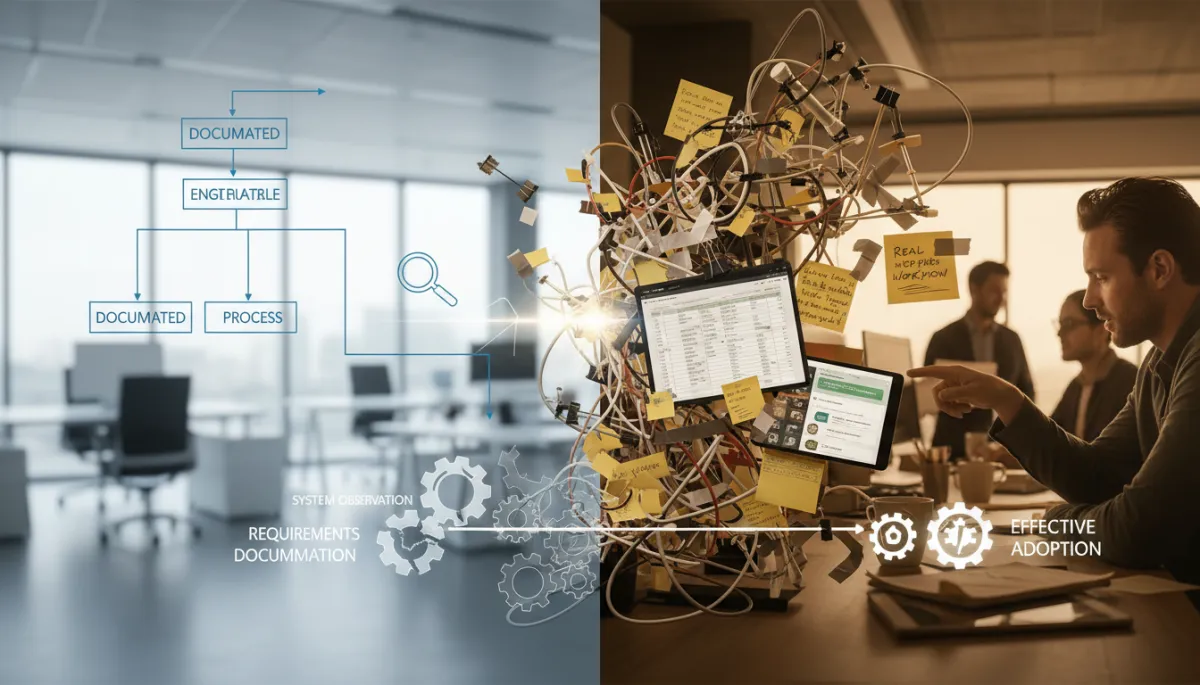
Why Paper Processes Fail in Business Workflows
Business Processes, Automation Failures, Real Workflows, Requirements Documentation, System Observation, Effective Adoption
The Two Systems Inside Every Business: Why Paper Processes Fail and Real Workflows Win
Every agency and operations team believes they have one set of Business Processes. In reality, there are always two: the official, documented version the owner describes, and the real system built from spreadsheets, group texts, skipped steps, and self-invented fixes. At Bot-Brand, we see Automation Failures happen when leaders automate the wrong one. This article explains why “paper automation” fails in three predictable ways, how Real Workflows quietly reveal validated requirements, how to uncover the actual system by watching instead of asking, and why correctly built automations rarely need an adoption push.
The Documented Process vs. the Real Workflow
Ask an owner to describe their Business Processes and you will hear about neat stages, clear handoffs, and defined responsibilities. Ask the team to show you how work actually moves and you will see something else entirely: private spreadsheets, Slack or SMS group chats, notes on phones, and “I just do it this way because it’s faster.”
That second system—the lived, improvised one—is not sloppiness. It is the organization’s live Requirements Documentation in motion. People build workarounds only when the documented process does not fit the volume, exceptions, timing, or tools they face each day. When Bot-Brand engineers autonomous ecosystems, we treat these workarounds as high-value data, not as behavior to be “corrected.”

The gap between written procedures and Real Workflows is where most automation projects fail.
Why Automating the Paper Version Fails in Three Predictable Ways
When a business or agency asks a vendor to “automate our process,” they usually hand over the official SOPs, not the Real Workflows. The result is painfully consistent. The new system either:
Gets bypassed. The automation is perfectly aligned with the document and perfectly misaligned with reality. Staff quietly continue using their spreadsheets and group texts because the new tool slows them down or blocks edge cases. Logins drop after week one; reports show “poor adoption.”
Breaks on exceptions. The system works for the ideal scenario, then collapses when volume spikes, a new service type appears, or a client behaves unpredictably. Suddenly tickets get stuck, leads vanish, and managers declare the automation “unreliable.”
Is adopted and quietly useless. In the most deceptive case, everyone logs in, clicks the required buttons, and then reverts to real work elsewhere. The tool becomes a reporting shell—great dashboards, zero operational impact, and no reduction in manual effort.
All three Automation Failures share one root cause: the system was built to match the paper story, not the operational truth. It optimized what leaders thought should happen, not what actually delivers outcomes under pressure.
Every Workaround Is a Validated Requirements Document
High-volume local service businesses do not create workarounds for fun. They create them to survive. A custom spreadsheet that tracks nuanced job statuses, a shared inbox rule that reroutes certain clients, a dispatcher’s color-coding system—each of these is a live Requirements Documentation artifact shaped by real constraints:
The timing at which information actually arrives
The exceptions that occur often enough to matter
The gaps between systems that no one officially owns
📌 Key Takeaway: If your team repeatedly uses a workaround, it is not “non-compliance.” It is proof that your Real Workflows require capabilities your documented process never accounted for.
At Bot-Brand, we treat these artifacts as hard data. They are prioritized inputs into our Neural Intercept Protocol, informing how AI voice and chat agents should interpret context, qualify leads, and synchronize data with zero human intervention.

Workarounds, when mapped carefully, become precise blueprints for effective automation.
Finding the Real System: Watch, Do Not Ask
If you ask, “How does a lead move through your agency?” you will hear the idealized version. To uncover Real Workflows, you must observe the work happening in real time. System Observation is the bridge between concept and reality.
Shadow the process end-to-end. Sit with the person who first receives the inquiry, then follow the next handoff, and the next. Note every tool they touch—CRM, email, SMS, calendar, payment portal, internal chat.
Capture deviations, not just steps. Ask, “What do you do when this doesn’t fit the normal pattern?” Those exception paths usually account for a disproportionate share of stress and lost revenue.
Quantify friction. Where do people retype data, chase missing details, or wait on approvals? These are prime candidates for autonomous AI intervention.
This level of System Observation is how Bot-Brand designs infrastructure that does not merely digitize a checklist but reconstructs the real system with precision logic and architectural integrity.

Watching real behavior reveals requirements no interview or SOP ever captures.
Why Correct Builds Rarely Need an Adoption Fight
When automation is aligned with Real Workflows, Effective Adoption is not a change-management battle; it is a relief. Teams switch because the new system:
Removes steps they dislike, instead of adding oversight they resent
Handles exceptions they used to juggle manually, instead of failing when reality gets messy
Mirrors the language, timing, and tools they already use, instead of forcing a foreign workflow
In high-volume environments, people gravitate to whatever keeps them out of chaos. A correctly built autonomous system—especially one that intercepts, qualifies, and synchronizes leads 24/7 with human-grade nuance—becomes the obvious choice. Training becomes a short orientation, not a cultural war.
From Paper to Precision: Your Next Step
If your past automation projects have been bypassed, broken by exceptions, or quietly useless, the issue is not your people—it is the gap between documented and real Business Processes. By treating workarounds as validated Requirements Documentation and investing in disciplined System Observation, you can build autonomous infrastructure that your team adopts willingly because it reflects how they truly operate.
Bot-Brand specializes in closing that gap with AI-driven ecosystems and the Neural Intercept Protocol, designed for high-velocity, high-integrity operations. If you are ready to see how your real system behaves—and how it can be rebuilt for true autonomy—initialize a Secure Uplink for an Architectural Audit and Systems Diagnostic.