You Followed Up Once. That's Why You Lost the Job.
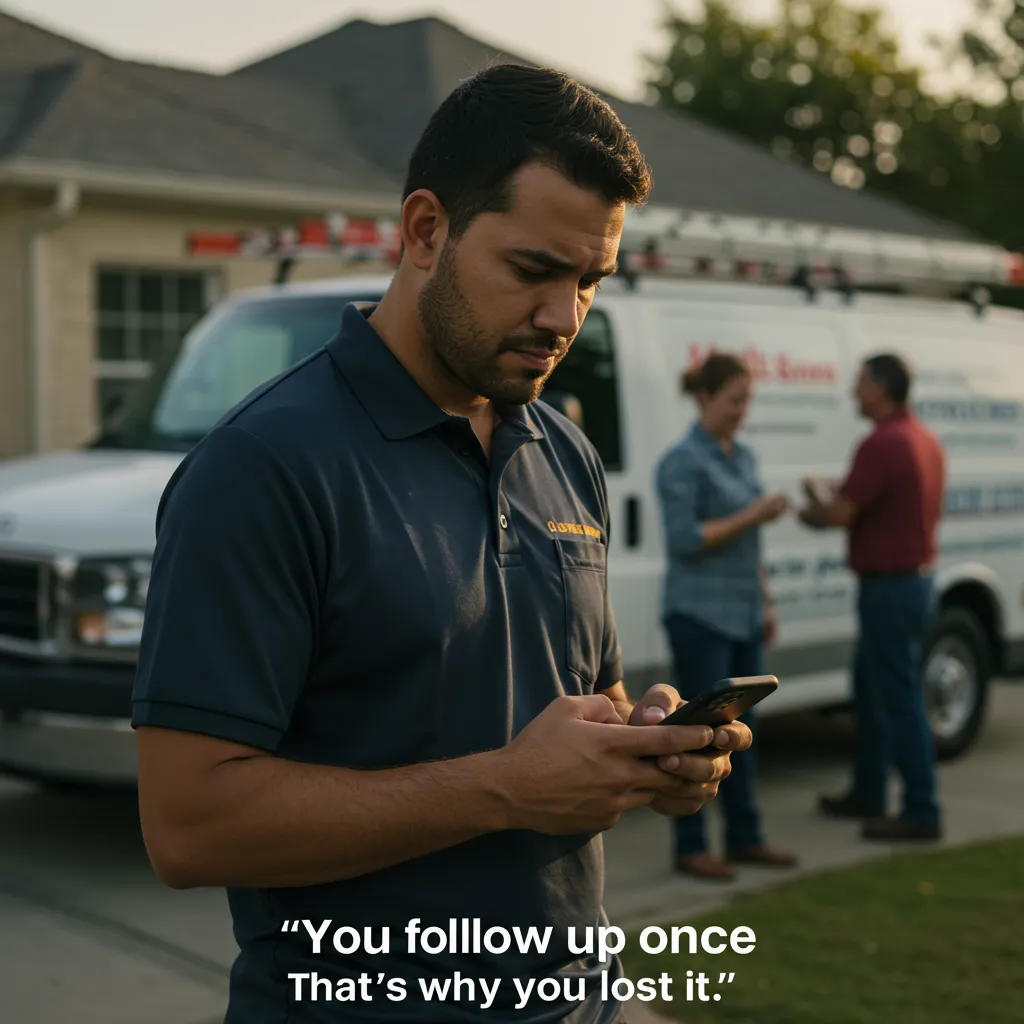
You called them back. You left a message. You waited a day, maybe two. Nothing. So you moved on.
That's not a lead problem. That's a follow-up problem — and it's costing you more work than you realize.
Here's what actually happens in most trades businesses: a lead comes in, the owner or the office calls once, gets voicemail, leaves a message, and mentally files that person under "they'll call back if they're serious." They don't call back. Not because they weren't serious — but because two other companies kept showing up in their inbox and their phone.
The guy who got the job wasn't necessarily better. He just didn't quit.
---
This is the part of the business that nobody talks about because it's uncomfortable. It implies that the reason you're losing work isn't your pricing, your reputation, or the quality of what you do. It's that you stopped too early. One follow-up attempt feels polite. It feels professional. But to someone who's been busy, distracted, or just slow to decide — one call and a voicemail means you weren't that interested either.
Sales research from the National Sales Executive Association has been cited for years around this pattern: the majority of sales require five or more follow-up contacts, and the majority of salespeople quit after one or two. Whether that exact data holds for your industry or not, anyone who's been in the trades long enough has lived this firsthand. You follow up once, life happens, and the lead goes cold — not because they chose someone else in that moment, but because the next person who showed up was the one who got the appointment.
The truth is that most small business owners don't have a bad sales process. They have an incomplete one. They built the front end — the website, the Google profile, the request form — and they handle the close well when they're in front of someone. But the middle? The follow-up sequence that bridges initial interest to booked appointment? That part runs on whoever has time, which usually means it barely runs at all.
---
This is exactly the gap that AI automation was built to fill.
Not because AI is smarter than you. Not because it closes better than a trained human. But because it doesn't forget, it doesn't get tired, and it doesn't decide that someone "probably isn't serious" after one ignored message. It follows a contact through a defined sequence — text, email, follow-up text, check-in — and it keeps going until it gets a response. Yes or no. Booked or opted out. Not silence.
The Neural Bridge infrastructure Bot-Brand builds into a business doesn't just capture a lead when they come in. It runs a full follow-up sequence on a schedule, adjusts based on how the contact responds, and hands the conversation off to the owner only when it's warm. You're not chasing anymore. You're receiving.
That's a different kind of business.
For a roofer running a crew, a pest control operator out on routes, or an HVAC tech who spends half his day under houses — the follow-up sequence is the one thing that almost never gets done consistently. There's no time. There's no system. And every time a lead goes dark after one attempt, the assumption is that it just wasn't meant to be.
Some of them weren't. But a lot of them were. And they're on a competitor's schedule right now because that competitor had a system and you had intentions.
---
Intentions don't book appointments. Infrastructure does.
Bot-Brand builds the follow-up layer that most small businesses are missing — the automated sequence that works the lead from first contact to confirmed appointment without you having to touch it. It runs on your brand, your voice, your offer. You just show up to the jobs.
If you've been relying on one call and a voicemail to do the work of a sales system, you already know what that costs you. You just haven't put a number on it yet.
There's a Diagnostic Lab at bot-brand.com that takes about five minutes. It shows you where your current automation infrastructure stands — and where the gaps are. No pitch meeting, no obligation. Just a clear picture.
If you're ready to stop leaving work on the table, start there.